


The astronomical precision
behind your star map.
Real catalogues. Real coordinates. Real spectral colours. Every star on a Skylit print is positioned and tinted using the same data that observatories trust — calculated for your exact date, time, and place.
At Skylit Studio, our star maps are more than decorative keepsakes — they're grounded in the same astronomical data used by observatories, educators, and amateur astronomers around the world. Every star is plotted at its true position, sized to its real apparent brightness, and tinted to its actual spectral colour.
Real star colours, just as they appear in the sky.
Every star on a Skylit map is rendered in its true spectral colour — a reflection of its surface temperature and astronomical classification.
From the blazing blue of young O-type stars to the warm glow of ancient M-class giants, every star reflects its real-world light. The star you see on your map is coloured as it actually appeared in the sky — on your chosen date, at your chosen place.
Why you see more blue and yellow than red.
Red stars are actually the most common in the universe — M-type red dwarfs make up over 75% of all stars in our galaxy. They're just very small, very cool (~2,500–3,500 K), and very dim — they emit almost no visible light, so they're typically too faint to see with the naked eye.
Our maps use high-accuracy star catalogues filtered by brightness (magnitude), typically including stars visible from Earth. That means A-, F-, G- and K-type stars (white to orange) are most prominent, some brilliant blue O- and B-types appear despite their rarity, and M-types are usually too faint to land on the chart.
So your star map shows more blues, whites and yellows because that's the sky as you'd actually see it — not just the cold statistics of stellar populations.
Understanding star magnitude.
Magnitude measures how bright a star appears from Earth. The lower the number, the brighter the star — our maps include stars up to magnitude 6, the faintest visible to the naked eye under dark skies.
Bright ≠ always big.
It's easy to assume bigger dots mean bigger stars — but that's not always true. The size of a star dot represents how bright it appears from Earth, not how big the star actually is.
Sirius
- Brightest star in the sky
- Apparent magnitude: –1.46
- Type: A1V
- Size: ~2× the Sun
- Bright because it's very close — about 8.6 light-years away
Betelgeuse
- Red supergiant
- Apparent magnitude: ~0.5
- Type: M1–M2
- Size: ~700× the Sun
- Still bright despite being ~498 light-years away
A bright dot on your map could mean a star that's huge and far away, or small and very close. The night sky is full of those surprises.
Not just stars, the wandering planets.
The ancient Greeks called them planḗtēs — "wanderers" — because, unlike the fixed stars, they drift steadily against the constellations from night to night. When one shared your sky, your map shows it as more than a dot.
On a given night, up to five planets can be bright enough to see with the naked eye. If Venus blazed over your city or Mars burned red on your chosen date, it belongs on your map. Rather than a generic marker, Skylit renders each visible planet as a true photographic disc, built from the same imagery the space agencies release: MESSENGER at Mercury, Hubble at Mars and Saturn, Cassini at Jupiter, Voyager 2 at Neptune.
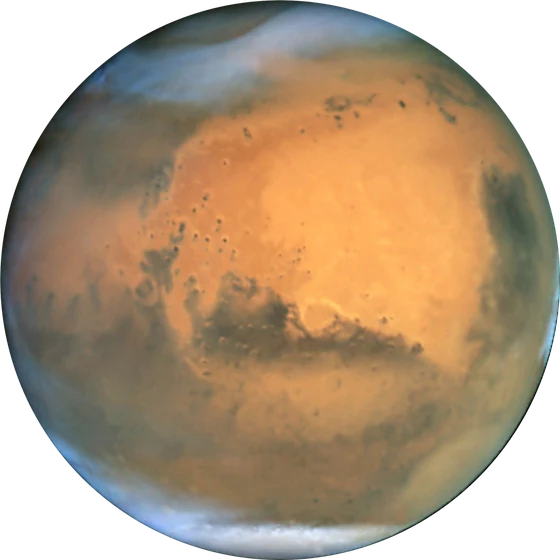
The Red Planet. Iron-oxide dust across its surface gives Mars a warm, rusty tint that stands out among the white and blue stars.
These are not illustrations. Every planet here is the same asset that lands on a finished print, drawn from real spacecraft and telescope imagery, and it appears on your map only if it was genuinely above the horizon at your moment. The five bright planets, Mercury through Saturn, are visible to the unaided eye; Uranus and Neptune are fainter ice giants that reward a pair of binoculars. Imagery: NASA · ESA · MESSENGER · Mariner 10 · Hubble (OPAL) · Cassini · Voyager 2.
Where the data comes from.
Aesthetic design is blended with accurate celestial positioning, sourced from internationally trusted astronomical catalogues.
Hipparcos & Tycho-2
The core of our positional data. Compiled by the European Space Agency, these catalogues provide highly accurate coordinates and brightness measurements for over 2 million stars.
Gaia Data Release
The most current publicly available release, enhancing the accuracy of star locations and proper motions — refining how each star is positioned on the final map.
Saguaro Astronomy Club
Referenced for deep-sky objects such as galaxies, nebulae and star clusters — adding depth and context to the chart beyond simple stars.
IAU Constellations
Constellation outlines use the official boundaries defined by the International Astronomical Union — the global authority in astronomy — so every constellation is scientifically correct.
Location, date & time precision.
Every star map is generated based on Earth's exact orbital position (date), axial spin (time of day), and global coordinates (location) — capturing the unique sky from any moment in time.
Maps are then enhanced with high-resolution sky imagery and deep-space visuals — Wright's Milky Way render and custom-designed celestial assets — so the final piece has a real-photo finish without sacrificing scientific accuracy.
See that same sky for yourself. Our free Night Sky Explorer is a live planetarium you can travel through by date, time and place, so you can find the exact moment before you ever print it.
Giclée prints, archival ink.
Every print is produced on an award-winning giclée printer using archival pigment inks on Photo Lustre paper. The result is a beautiful finish with deep blacks, true colour reproduction, and longevity rated in the decades.
Every star map is computed from established astronomical catalogues and algorithms, so the geometry, colours and star brightness reflect the real sky over your exact date, time and place. We then size and finish that sky for print, so each piece is a faithful record of the moment, made to live beautifully on your wall.

Your personalised Constellation Legends eBook.
Every star map order comes with a companion eBook written for your exact date and place — the myths behind your stars, the science behind their light.
- Your constellations, identified — the patterns that stood over you on your night, named one by one.
- Their legends — the heroes, queens and creatures cultures saw in those same stars.
- The science behind their light — what the brightest stars on your map really are.
Emailed after purchase as an interactive flipbook and downloadable PDF — yours to keep, or to send on as a gift.
Ready to capture your sky?
Pick a date, a time, a place. We'll plot the sky exactly as it appeared from there.
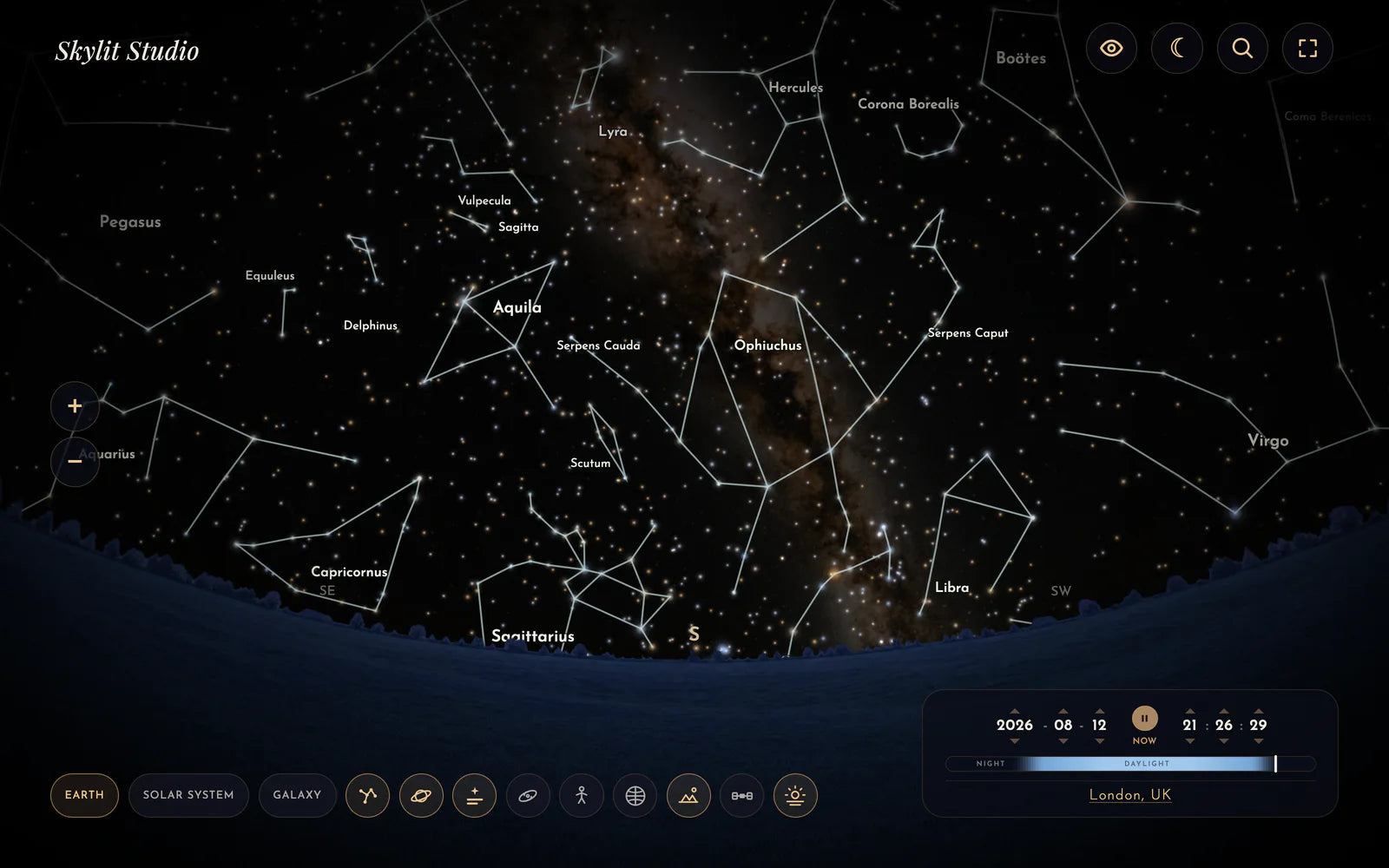
Free interactive tool
Explore the night sky for any date and place
Our free Night Sky Explorer is a live planetarium in your browser. See the real stars, constellations, planets, Moon and Milky Way exactly as they were, travel through time, and when you find a moment worth keeping, turn it into a print.
Open the Night Sky Explorer →
