


There are 88 official constellations, not 12. The zodiac uses only a twelfth of the night sky: Andromeda, Cygnus, Vela, Pyxis, Camelopardalis and seventy-one others are every bit as official, sitting in the very same sky, simply without a horoscope column to their name. So why does everyone stop counting at twelve?
The short answer is geography: not Earth's, but the Sun's. Only a narrow band of the sky lies along the Sun's yearly path, and roughly three thousand years ago Babylonian astronomers carved that band into twelve tidy slices and borrowed twelve constellation names to label them. The other seventy-six were left out of astrology entirely, through no fault of their own. Below is the complete list of all 88, which twelve made the cut, the thirteenth the Sun crosses that nobody talks about, and how the official borders were drawn in the first place.
Why Only 12 of the 88 Became Star Signs
Picture the sky as a full sphere wrapped around the Earth. The Sun does not wander freely across it. From our point of view it traces one fixed circle over the course of a year, a line astronomers call the ecliptic, and that circle only ever touches a thin ribbon of the whole celestial sphere.
Everything the Sun passes in front of during that circuit was, to ancient sky watchers, calendar-relevant. If you knew which stars the Sun was hiding, you knew roughly where you were in the agricultural year. That made a small handful of constellations enormously useful and left the rest as scenery. Babylonian astronomers divided the ribbon into twelve equal 30 degree segments, one for each lunar month in a year, and named each segment after a constellation sitting in it at the time.
So the twelve were not chosen for beauty, brightness or size. Orion is more striking than Cancer by any measure. Ursa Major is more recognisable than Capricornus to most people in Britain. They simply sit off the Sun's path, and a calendar built on the Sun's position had no use for them.

The twelve famous constellations were not the finest in the sky. They were simply the ones standing in the Sun's way.
Skylit StudioAll 88 IAU Constellations: The Full List
Here is the complete official list, alphabetically. The twelve marked with a star lent their names to the zodiac. Ophiuchus, marked separately, sits on the Sun's path too but never became a sign. The remaining seventy-five have no connection to astrology whatsoever.
✦ gave its name to a zodiac sign ☉ on the Sun's path, but never became a sign
A few of the names give away their history. Antlia is an air pump, Microscopium a microscope, Telescopium a telescope, Pyxis a mariner's compass. These are not ancient myths at all: they were invented in the 18th century by French astronomer Nicolas-Louis de Lacaille, who filled the sparse southern sky with the instruments of the Enlightenment rather than gods and heroes.
What an IAU Constellation Actually Is
The International Astronomical Union is the body responsible for standardising astronomy worldwide. In 1930, Belgian astronomer Eugène Delporte mapped out 88 official constellation boundaries covering the entire celestial sphere, leaving no patch of sky unclaimed. Every star belongs to exactly one constellation region.
The crucial point, and the one that trips most people up, is that a constellation is not the join-the-dots figure. It is an area. The boundaries are precise shapes defined in right ascension and declination, the celestial equivalent of longitude and latitude. When astronomers say a nebula lies "in Orion" or a galaxy lies "in Virgo", they mean it falls inside that officially demarcated region of sky, whether or not it sits anywhere near the famous stick figure.
The 88 include the shapes British stargazers know well, such as Orion, Ursa Major and Cassiopeia, alongside dozens of southern constellations most of us will never see, such as Vela, Pictor and Musca. Many of those were catalogued by European navigators charting the southern skies in the 16th and 17th centuries.
The 13 Constellations the Sun Really Crosses
Astrology divides the year into 12 equal signs of roughly 30 days each. The sky does not co-operate. Because the 88 IAU constellations vary enormously in size, the Sun spends about six weeks crossing Virgo and barely a week crossing Scorpius. It also spends nearly three weeks in Ophiuchus, the constellation that missed out on the zodiac despite standing right in the Sun's way.
These are the constellations the Sun genuinely passes in front of, using the official IAU boundaries rather than the equal astrological divisions. Dates shift by a day either way depending on the year.
| Constellation | Sun passes through (approx.) | Roughly how long |
|---|---|---|
| Capricornus | 19 January to 15 February | 28 days |
| Aquarius | 16 February to 11 March | 24 days |
| Pisces | 12 March to 18 April | 38 days |
| Aries | 19 April to 13 May | 25 days |
| Taurus | 14 May to 19 June | 37 days |
| Gemini | 20 June to 20 July | 31 days |
| Cancer | 21 July to 9 August | 20 days |
| Leo | 10 August to 15 September | 37 days |
| Virgo | 16 September to 30 October | 45 days |
| Libra | 31 October to 22 November | 23 days |
| Scorpius | 23 November to 29 November | 7 days |
| Ophiuchus (not a zodiac sign) | 30 November to 17 December | 18 days |
| Sagittarius | 18 December to 18 January | 32 days |
Compare that with your horoscope dates and the mismatch is obvious. Western astrology uses the tropical zodiac, which is pinned to the seasons rather than to the stars, so the twelve signs stayed where they were while the real sky drifted by roughly a whole sign over the past two thousand years. Both systems are internally consistent. They are just answering different questions, and our complete guide to the twelve zodiac signs covers the astrological side in its own right.
Signs and Constellations Side by Side
| Feature | IAU Constellations | Zodiac Signs |
|---|---|---|
| Total count | 88 | 12 |
| Coverage | Entire sky | Ecliptic band only |
| Basis | Precise celestial coordinates | Equal 30-degree divisions |
| Sizes | Wildly uneven (Hydra is the largest) | All identical, 30 degrees each |
| Primary use | Astronomy, star catalogues, sky maps | Astrology, horoscopes, calendars |
| Standardised by | IAU (1930) | Ancient Babylonian tradition |
| Shifts with precession? | Boundaries fixed to celestial coordinates | Tropical zodiac does not; sidereal zodiac does |
How the Boundaries Were Drawn
Before 1930 there was no agreed answer to the question "which constellation is this star in?". Different atlases drew different outlines and stars near the edges belonged to whoever was doing the drawing. Eugène Delporte settled it for the IAU by dividing the entire celestial sphere into 88 closed regions whose edges run along lines of constant right ascension and constant declination, producing the familiar stepped, staircase-shaped borders.
Three things about those boundaries tend to surprise people:
- They are fixed to the B1875.0 coordinate frame, the standard epoch in use when Delporte drew them. Precession has since rotated the coordinate grid, so on a modern star chart the boundaries look slightly tilted rather than perfectly square.
- They are areas, not outlines. The stick figure of Orion is a convention. The Orion boundary is the region of sky around it, and every object inside that region is officially "in Orion".
- They cover everything. There is no unclaimed sky. Every star, galaxy and comet has exactly one constellation address at any moment.
That is also why boundary questions have crisp answers. The border between Pisces and Aries, for instance, is a stepped line of constant B1875 right ascension and declination, and the point where it crosses the ecliptic is the moment the Sun leaves Pisces and enters Aries, around 18 or 19 April each year. The official coordinate data for all 88 regions comes from Delporte's 1930 catalogue, still distributed today as the IAU constellation boundary dataset.
A constellation is not a picture. It is a plot of land in the sky, with a deed drawn up in 1930 and borders you can look up to the second.
Skylit StudioWhich of the 88 You Can See From Britain
Not all 88 are available to you. From UK latitudes the far southern constellations such as Crux, Octans and Musca never rise above the horizon at all, while Ursa Minor and Cassiopeia are circumpolar and never set. In between sits everything seasonal: Orion dominating winter evenings, Cygnus and Lyra overhead in summer.
Realistically that leaves somewhere around sixty constellations within reach of a British back garden across a full year, and far fewer on any single night. Our guide to the constellations in the UK sky works through which ones to look for season by season, and if you would rather know what is up right now, tonight's sky over the UK covers what is visible without any equipment.
Make it personal
 Personalised Star Map | Custom Night Sky Print
From £21.99
View product →
Personalised Star Map | Custom Night Sky Print
From £21.99
View product →
 Personalised Moon Map | by Skylit Studio
From £21.99
View product →
Personalised Moon Map | by Skylit Studio
From £21.99
View product →
 Personalised Moon Phase Map for Family | by Skylit Studio
From £21.99
View product →
Personalised Moon Phase Map for Family | by Skylit Studio
From £21.99
View product →
 Custom Location Map | Personalised Map Print by Skylit Studio
From £21.99
View product →
Custom Location Map | Personalised Map Print by Skylit Studio
From £21.99
View product →
 Your Name From Orbit
From £21.99
View product →
Your Name From Orbit
From £21.99
View product →
 Print Your Universe - Custom Image Print
From £19.79
View product →
Print Your Universe - Custom Image Print
From £19.79
View product →
Why This Matters on a Star Map
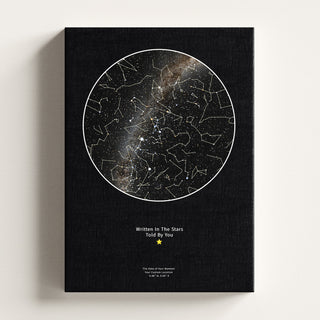
Which constellations appeared on any given night depends entirely on your date, time and location, and that is exactly what a personalised star map from Skylit Studio records. The print shows a scientifically accurate rendering of the sky as it appeared at one specific moment, from one specific place on Earth, which means it is drawn from the 88 IAU constellations rather than the twelve astrological signs.
The constellation outlines on your print reflect the same boundaries used by professional observatories and planetarium software. They show which stars were overhead at midnight on your anniversary, which part of the sky was rising as a child took their first breath, or how the sky looked above the coordinates where you said "I do".
This level of astronomical precision is what separates a star print from a decorative poster. It also means your zodiac constellation may well appear, if it happened to be above the horizon at your chosen moment, alongside dozens of others that shared the sky that night. Twelve names get the attention. A star map gives you all of them that were actually there.
Twelve names get the attention. A star map gives you every constellation that was actually overhead.
Skylit StudioFind Your Own Constellations
Curious which of the 88 were above you on a date that matters, or which one the Sun was really travelling through when you were born? You do not need to guess. Skylit Studio's free Night Sky Explorer lets you dial in any date, time and location to see an interactive map of the sky at that exact moment. Identify constellations, track planets, and get a feel for what a finished print would show before you commit to anything.
It costs nothing to use. If you want the background on how the calculation works, we have written up how the sky is reconstructed for any date and location, and the how it works page walks through the three steps from choosing your date to receiving your print.
Moon Phase Maps: A Different Kind of Celestial Keepsake
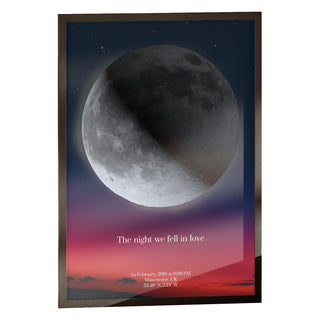
If the Moon draws you more than the star fields, a personalised moon map captures the exact lunar phase at your chosen moment. Whether the Moon was a waxing crescent on the night of an engagement or a full moon on a milestone birthday, the phase is calculated with the same rigour as the star maps.
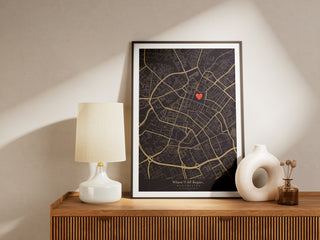
Moon prints work beautifully as standalone art because the lunar disc is bold and immediately readable across a room. For a place rather than a moment in the sky, a custom location map renders anywhere in the world in Skylit Studio's house style, at whatever zoom you choose, from a whole city down to a single street, with an optional pin marking the exact spot.
How to Choose the Right Print
A quick guide to matching the right Skylit Studio print to the occasion:
- A key date and location matter most: a personalised star map is the natural choice. It captures the full celestial scene, constellations and all, from your exact coordinates.
- You want something bold and graphic: a moon map gives you the shape of the lunar disc at your chosen moment.
- You want to celebrate a place: a custom location map turns meaningful ground into wall art.
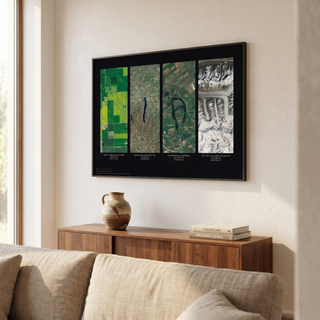
- You would rather mark a name than a moment: Your Name From Orbit spells a name out in real NASA Landsat and ESA Sentinel-2 satellite imagery, each letter a coastline or river whose natural shape forms it.
- Shopping for anniversary gifts: star maps and moon maps both suit. Capture your wedding night sky, or the moon on your first date.
- Looking for birthday gifts: a star map of the night someone was born is a keepsake they are unlikely to own already.
Prints start from £21.99 for A4 unframed, running up to 60x80 cm, with framed and canvas options at every size. You can add a frame and personalise the caption text to suit the occasion.
Conclusion
Twelve constellations became household names because of an accident of geometry: they happened to lie along the one circle the Sun traces through the sky each year, and a calendar was built on them. The other seventy-six are no less real, no less officially named, and in several cases considerably more spectacular. The IAU's 88 regions divide the whole celestial sphere between them, and every star you have ever noticed belongs to one of them.
When Skylit Studio creates your personalised star map, it is built on that astronomical framework rather than the astrological one: real star positions and real IAU boundaries for a specific date, time and place. The result is a faithful snapshot of a sky that genuinely existed, over a real place, at a real moment.
Frequently Asked Questions
How many constellations are there?
There are exactly 88 official constellations, standardised by the International Astronomical Union in 1930. Together they divide the entire celestial sphere into 88 named regions with formally defined borders, so every star in the sky belongs to one, and only one, constellation. Astrology's 12 zodiac signs are a separate and much smaller system: they borrow 12 of those names and apply them to equal 30 degree slices of the Sun's path.
Why are there only 12 zodiac signs when there are 88 constellations?
Because the zodiac was never meant to catalogue the sky. It was a calendar. Only the constellations lying along the ecliptic, the Sun's apparent yearly path, were useful for tracking the seasons, and Babylonian astronomers split that narrow band into twelve equal segments to match the twelve lunar months in a year. Twelve constellations sitting in the band supplied the names. The other seventy-six were simply not on the Sun's route, so they were never part of the system, no matter how bright or famous they are. Orion, Cygnus and Ursa Major are all in that group.
Why is Orion not a zodiac sign?
Because the Sun never passes in front of it. The zodiac only includes constellations that sit on the ecliptic. Orion lies just south of it, close enough that the Moon and occasionally a planet can clip its northern edge, but the Sun itself never crosses into the Orion region. The same applies to Ursa Major, Cassiopeia and Cygnus: all are official IAU constellations, none is a star sign, purely because of where they sit relative to the Sun's path.
Are zodiac signs constellations?
Not quite. Zodiac signs are named after constellations, but they are not the same thing. A sign is an equal 30 degree segment of the ecliptic used in astrology. A constellation is an irregular region of real sky defined by the IAU. The two drifted apart because of precession, so the sign called Aries and the constellation called Aries no longer occupy the same stretch of sky. There is also a thirteenth constellation on the Sun's path, Ophiuchus, which has no corresponding sign at all.
What is the IAU constellation boundary between Pisces and Aries?
It is a stepped line running along fixed values of right ascension and declination in the B1875.0 coordinate frame, the epoch Eugène Delporte used when he drew the official borders for the IAU in 1930. Practically, the point that matters is where that border crosses the ecliptic, because that is the exact place the Sun leaves Pisces and enters Aries, which happens around 18 or 19 April each year. Precession has tilted the B1875 grid relative to today's coordinates, which is why the border looks slightly skewed on a modern chart. Full coordinate data for this and every other border comes from Delporte's published boundary catalogue.
What is a zodiac boundary?
It depends which system you mean, and this is where most confusion starts. In astrology, a zodiac boundary is simply the point where one 30 degree sign ends and the next begins, evenly spaced and tied to the seasons. In astronomy, the boundary is the real IAU border between two constellations, drawn along lines of right ascension and declination and wildly uneven in size. The Sun spends 45 days crossing Virgo and only 7 days crossing Scorpius, so the astronomical boundaries produce nothing like the tidy monthly blocks of a horoscope.
Are constellations astronomy or astrology?
Both use the word, but they mean different things by it. The 88 constellations are an astronomical convention: a coordinate system for naming and locating everything in the sky, maintained by the IAU and used by every observatory in the world. Astrology uses 12 of those names as labels for divisions of the ecliptic and attaches meaning to them. A Skylit Studio star map is built on the astronomical version: real star positions and real IAU boundaries for a specific date, time and place.
What is the difference between a constellation and a zodiac sign?
A constellation is an officially defined region of the sky as recognised by the International Astronomical Union. There are 88 of them, covering every part of the celestial sphere. A zodiac sign is one of 12 equal divisions of the ecliptic, the Sun's apparent path through the sky, used in astrology. The zodiac borrows its names from 12 of the constellations that sat along the ecliptic roughly 3,000 years ago, but the two systems are distinct. A personalised star map uses IAU constellation data, not zodiac divisions.
Has my star sign drifted or changed over time?
In a real sense, yes. Earth's axis slowly wobbles in a cycle known as precession, which has shifted the Sun's position against the background stars by roughly one whole sign over the past 2,000 years. Western astrology uses the tropical zodiac, which is tied to the seasons rather than the actual constellations, so your horoscope sign has stayed the same even though the real sky has moved on. Astronomers also recognise a 13th constellation, Ophiuchus, sitting along the Sun's path. To see exactly which constellations were overhead at your chosen moment, try the free Night Sky Explorer.
Will my zodiac constellation appear on my star map?
It may, depending on your chosen date, time and location. Your zodiac constellation is simply the IAU constellation the Sun was travelling through when you were born. On any given night it may or may not be above the horizon. Our star maps show all visible constellations for your chosen moment, so if it was in the sky, it will be there. Use the free Night Sky Explorer to check before you order.
How accurate are Skylit Studio star maps?
Our maps are generated using professional astronomical algorithms that calculate star positions, constellation boundaries and celestial coordinates to the minute for any date and location on Earth. You can read more about the methods behind the prints on our astronomical precision page.
Are star maps good gifts for anniversaries and birthdays?
They are among the most personal gifts you can give. For anniversary gifts, capturing the night sky from your wedding venue or the place you first met creates something specific to your relationship. For birthday gifts, a map of the sky on the night someone was born is a keepsake they are unlikely to already own. Prices are as listed above, starting at A4 unframed.
How long does delivery take?
Orders placed by 3pm on working days (Monday to Friday) are dispatched the same day. Standard delivery via Royal Mail Tracked 48 takes 2 to 4 business days and is free. Next Working Day delivery is available for £6.95. See our how it works page for the full process from order to doorstep.
Can I get a moon map instead of a star map?
Yes. A personalised moon map shows the exact lunar phase at your chosen date and location. It is a good alternative if you prefer the bold, graphic look of the Moon over a full star field, and it carries just as much astronomical meaning. It is offered in the same sizes and finishes as the star maps.


