


Set an alarm for the early hours of Friday 28 August 2026. Before dawn that morning, the full Moon slides deep into the Earth's shadow and turns a dusty shade of copper. It is billed everywhere as a blood moon, and for once the hype is close to fair: 93% of the lunar disc will be swallowed by the darkest part of our planet's shadow, so what you see will look, to the naked eye, near enough total.
There is a catch, and it is worth knowing before you commit to the alarm. From the UK, this eclipse happens low in the west-south-west as the sky is already brightening, and the Moon sets before the show finishes. This guide covers the real timings, what to expect at each stage, and how to give yourself the best chance of actually seeing it.
What Is a Blood Moon, Actually?
A lunar eclipse happens when the Sun, Earth and Moon line up and the full Moon passes through the shadow the Earth casts into space. That shadow has two parts. The outer penumbra is a faint half-shade that barely dims the Moon at all. The inner umbra is the proper shadow, and that is where the colour comes from.
Here is the part that surprises people. Inside the umbra the Moon should logically vanish, because the Earth is blocking direct sunlight. It does not vanish, because our atmosphere bends a little sunlight around the planet's edge and drops it onto the lunar surface. On the way through, the air scatters short blue wavelengths away and lets long red ones through, exactly the process that makes our own sunsets red. What lands on the Moon is the combined light of every sunrise and sunset on Earth at that moment, which is why the disc glows rather than going black. The exact shade, rust, brick or copper, depends on how much dust and cloud sits around the Earth's limb, and nobody can tell you in advance which you will get.
UK Timings for the 28 August 2026 Lunar Eclipse
This is a partial eclipse, but a very deep one. At maximum, the umbral magnitude reaches roughly 0.93, meaning 93% of the Moon's diameter sits inside the umbra. Only a thin sliver along one edge stays in sunlight. All times below are British Summer Time on the morning of Friday 28 August 2026.
Eclipse Timings, UK (BST)
- 02:24 Moon enters the penumbra. Almost no visible change.
- 03:34 Partial eclipse begins. A dark bite appears on the lunar edge.
- 05:13 Maximum eclipse. Around 93% of the Moon is in shadow and glowing copper.
- From roughly 06:13 The Moon sets across the UK, still between about a fifth and a half in shadow.
- Just before 07:00 The partial phase formally ends, by which point the Moon is below the UK horizon.
Moonset runs a little later the further west and south you are, from around 06:13 in the north-east of England to nearer 06:35 on the far western coasts and in Dublin. The Sun is already up by then, so the final act plays out in full daylight low on the horizon. The practical takeaway: the window that matters is roughly 04:00 to 05:30 BST.
Hour by Hour: What You Will Actually See
02:24 to 03:30, the penumbral phase
Skippable. The Moon looks like an ordinary full Moon with a faint grey wash on one side. Photographs pick it up better than eyes do.
03:34 to 04:30, the shadow arrives
Now it gets good. A curved dark edge creeps across the lunar disc, and the curve itself is worth a second of thought. That arc is the shadow of the Earth, and its shape is one of the oldest recorded arguments that our planet is a sphere.
04:30 to 05:13, the copper hour
The eclipsed portion stops looking merely dark and starts looking coloured. By maximum at 05:13 the Moon is a low copper disc with a bright rim along the bottom edge, sitting about eight degrees above the west-south-west horizon, less than one outstretched fist held at arm's length.
05:13 to moonset, the fade
Twilight strengthens fast and the colour washes out as the Moon drops. After about 05:30 you are watching an eclipsed Moon against a dawn sky rather than a dark one, which is no bad thing: a copper disc sinking behind rooftops, hills or trees with dawn colour behind it beats a technically perfect Moon high in a black sky.
The red on an eclipsed Moon is every sunrise and sunset on Earth, projected at once onto a rock a quarter of a million miles away.
Skylit StudioWhere to Watch From: Your Horizon Matters More Than Your Sky
For most night-sky events, the advice is to escape light pollution. This one is different. The Moon is bright enough to shrug off streetlights, so the single thing that decides whether you see it is whether you have a clear, unobstructed view towards the west-south-west, down to within about five degrees of the horizon.
A garden hemmed in by houses will not do it. What works is a west-facing coast, a hilltop with the land falling away to the west, an upstairs window on that side, or a flat field. Check the sightline in daylight the day before, because at four in the morning you will not want to be hunting for a gap in the treeline. If you are planning to make a trip of it, our guide to the best stargazing spots in the UK is a good place to start, favouring anywhere with an open western aspect.
How to Watch and Photograph It With No Equipment
Lunar eclipses are the most democratic event in astronomy. No telescope, no filter, no eye protection. Just look up, safely and directly, in a way you never can during a solar eclipse.
- Eyes first. Give yourself ten minutes outside before maximum. The colour reads better once your eyes settle.
- Binoculars beat a telescope. Any ordinary pair pulls out the copper tone and the shadow edge beautifully, with a wide enough field to keep the whole disc in view.
- Phone cameras need help. Pointed at the Moon alone, a phone gives you a white blob. Instead, use night mode, prop the phone against a wall or use a small tripod, and compose the Moon with something on the ground: a chimney, a tree line, a church spire. The foreground gives the camera something to expose for and gives the photo a sense of place.
- Camera settings. With a DSLR or mirrorless, an eclipsed Moon is far dimmer than a full Moon. Start around ISO 800, f/5.6 and a shutter speed near half a second, then adjust as the bright remaining sliver may still blow out.
- Dress for it. Late August dawns are colder than people expect. A flask and a coat turn a shivering ten minutes into a comfortable hour.
If you are new to naked-eye observing, our guide to what you can see in the UK night sky without equipment pairs well with an eclipse morning.
Make it personal
 Personalised Star Map | Custom Night Sky Print
From £21.99
View product →
Personalised Star Map | Custom Night Sky Print
From £21.99
View product →
 Personalised Moon Map | by Skylit Studio
From £21.99
View product →
Personalised Moon Map | by Skylit Studio
From £21.99
View product →
 Personalised Moon Phase Map for Family | by Skylit Studio
From £21.99
View product →
Personalised Moon Phase Map for Family | by Skylit Studio
From £21.99
View product →
 Custom Location Map | Personalised Map Print by Skylit Studio
From £21.99
View product →
Custom Location Map | Personalised Map Print by Skylit Studio
From £21.99
View product →
 Your Name From Orbit
From £21.99
View product →
Your Name From Orbit
From £21.99
View product →
 Print Your Universe - Custom Image Print
From £19.79
View product →
Print Your Universe - Custom Image Print
From £19.79
View product →
Cloud: the Real Limiting Factor
Astronomers can predict this eclipse to the second, centuries either way. British weather, not so much. A low target makes cloud doubly punishing: you are looking through far more atmosphere than you would be overhead, and low cloud sitting on the horizon can hide the Moon while the sky above you looks perfectly clear.
So check a forecast that separates low, medium and high cloud rather than giving a single percentage, have a plan B location twenty minutes away on higher ground or nearer a west-facing coast, and go outside anyway, because gaps open and close on timescales no forecast captures. Anyone heading out for the Perseid meteor shower this week already knows the drill.
When Is the Next Lunar Eclipse Visible From the UK?
Worth knowing, because it changes how hard you should try for this one. The UK missed the total lunar eclipse of 3 March 2026 entirely, and after 28 August the next few lunar eclipses are either penumbral events barely worth the name or badly placed for these islands. The next total lunar eclipse properly visible from the UK falls on 31 December 2028, with totality in the early evening, a New Year's Eve blood moon that will be far easier to watch than a pre-dawn one.
So the honest framing is this. August 2026 gives you a near-total eclipse at an awkward hour and a low altitude, and 2028 gives you a proper one at a civilised time. If you can get up for it, do, because two and a half years is a long wait. For everything else worth diarising, see our 2026 UK celestial events calendar and the fuller 2026 astronomical events guide.
Keeping the Sturgeon Moon of 28 August 2026
The Moon being eclipsed that morning is the full Sturgeon Moon, August's full Moon in the traditional almanac naming. Eclipse mornings tend to stick in the memory: the alarm, the cold, the copper disc going down behind the houses. A photograph on a phone rarely does it justice.
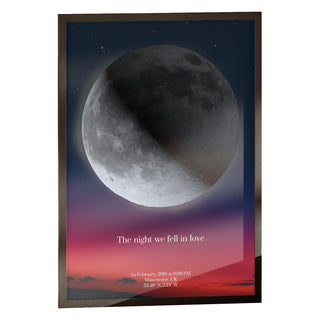
That is where a personalised moon phase print comes in. Enter a date and a place and Skylit Studio renders the Moon exactly as it appeared from there: the correct phase, the correct illuminated fraction, the real lunar surface rather than a decorative crescent. Choose 28 August 2026 and you get the full Sturgeon Moon, the one that spent that dawn in the Earth's shadow. You can read more about the process on our how it works page, or browse the full moon phase print collection.
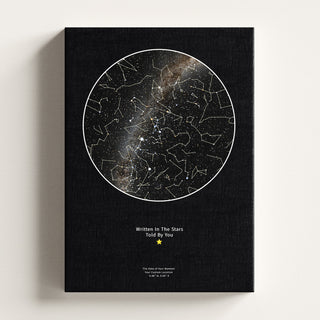
Of course, the date that matters most to you might not be an eclipse at all. A birth night, a wedding day, the evening you moved in. Families often line up one Moon per person across a single frame with the family moon phase print, and if you would rather have the whole sky than the Moon alone, a personalised star map plots the real stars overhead for any date, time and location. Prints start at £21.99 for an unframed A4, with framed and canvas finishes in larger sizes, dispatched the same working day on orders placed by 3PM Monday to Friday and delivered free within the UK on Royal Mail Tracked 48.
Frequently Asked Questions
Is the 28 August 2026 eclipse a total lunar eclipse?
No. It is a partial lunar eclipse, but a deep one, with about 93% of the Moon's diameter inside the Earth's umbral shadow at maximum. To the naked eye it will look close to total, with a thin bright sliver remaining along one edge.
What time is the blood moon in the UK?
The partial phase begins at 03:34 BST on 28 August 2026 and reaches maximum at 05:13 BST. The Moon then sets from around 06:13 BST onwards while still partly eclipsed, so the best viewing window is roughly 04:00 to 05:30 BST.
Which direction should I look?
West-south-west, and low. At maximum the Moon is about eight degrees above the horizon from the UK, so you need a clear sightline in that direction with no buildings, hills or trees in the way.
Do I need a telescope or eye protection?
Neither. Lunar eclipses are entirely safe to watch with the unaided eye. Ordinary binoculars will enhance the colour and the shadow edge, but they are optional.
Why does the Moon turn red instead of going dark?
Earth's atmosphere refracts sunlight around the edge of the planet and into the shadow. Blue light is scattered away and red light passes through, so the Moon is lit by the reddened light of every sunrise and sunset on Earth at that moment.
When is the next lunar eclipse properly visible from the UK?
The next total lunar eclipse fully visible from the UK is on 31 December 2028, with totality during the early evening. The lunar eclipses in between are either penumbral or poorly placed for British observers.
Can I get a print of the Moon on eclipse night?
Yes. A personalised moon phase print can be set to any date and location, including 28 August 2026, and will render the correct phase and illumination for that moment. You can also add a personal message printed beneath the design.


