



The headline half of 2026 has already been and gone: the 12th August solar eclipse dimmed the evening sky across Britain, and the Perseids peaked under a moonless sky the same night. The good news is that the year is far from finished. The next major event is only days away, and the run from October to Christmas holds three meteor showers and the largest full moon of the year.
This guide covers every astronomical event still ahead in 2026 for UK skies, dated, explained and with honest notes on what you will actually be able to see from a British garden. If you want the whole twelve months in one place, including a printable version, our free 2026 UK celestial events calendar has the full list and a downloadable PDF.
Still to Come in 2026
- 28th August: Deep partial lunar eclipse, 93% of the Moon in shadow before dawn
- Early October: Saturn at opposition, at its best for the year
- 21st-22nd October: Orionid meteor shower peak, debris from Halley's Comet
- 17th-18th November: Leonid meteor shower peak
- 24th November: Supermoon
- 13th-14th December: Geminid meteor shower peak, the year's most reliable shower
- 21st December: Winter solstice, the longest night of the year
- 24th December: The closest and largest supermoon of 2026, full at 01:29 that morning

The best of the UK stargazing year runs from late August through to Christmas
28 August: The Deep Lunar Eclipse
The next real event is close. Before dawn on Friday 28th August, the full Moon slides into the darkest part of the Earth's shadow and turns a dusty copper. It is technically a partial eclipse, but at maximum roughly 93% of the Moon's diameter sits inside the umbra, so to the naked eye it reads as near enough total.
There is a catch worth knowing before you set an alarm. From the UK this one happens low in the west-south-west while the sky is already brightening, and the Moon sets before the eclipse formally ends. The window that matters is roughly 04:00 to 05:30 BST, with maximum eclipse at about 05:13. What decides whether you see it is not dark skies but a clear, unobstructed horizon: a hilltop, a west-facing coast or an upstairs window looking the right way.
For hour by hour timings, moonset times across the country and how to photograph it, we have a dedicated guide to the 28 August blood moon and how to watch it from the UK.
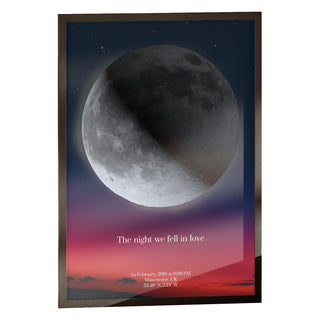
Because a lunar eclipse only happens at full moon, that night is also a full Moon in its own right. If the date carries meaning for you beyond the astronomy, a personalised moon phase print can show the Moon exactly as it appeared from your chosen place on that evening.
Autumn: Orionids, Saturn and Long Nights
Autumn is when British stargazing gets easy again. Darkness arrives before most people have finished dinner, and the summer haze of never-quite-night is gone.
Saturn reaches opposition in early October, meaning it sits opposite the Sun in our sky, rises at sunset and stays up all night. It is the best window of the year for the rings, and even a modest telescope will show them. The autumn equinox on 23rd September also opens one of the two annual windows when aurora activity tends to pick up, and with the Sun still running through an active stretch of its roughly eleven year cycle, northern Scotland has a genuine chance on a clear, settled night.
The Orionid meteor shower peaks on 21st-22nd October. These are fragments of Halley's Comet burning up at around 66 kilometres per second, which makes them fast and often leaves brief glowing trails. Rates are modest, typically 15 to 25 an hour under good conditions, and a bright waxing Moon is in the sky for much of this year's peak, so the fainter meteors will be washed out. Look in the hours before dawn once the Moon is low, and expect the brighter ones.
Best UK Locations for Dark Skies and Aurora
- Northern Scotland, especially the Highlands and Islands
- Northumberland Dark Sky Park
- Galloway Forest Dark Sky Park
- Exmoor Dark Sky Reserve
- Bannau Brycheiniog, the Brecon Beacons
November: Leonids and a Supermoon
The Leonids peak on 17th-18th November. In an ordinary year they deliver perhaps 10 to 15 meteors an hour, though the Leonids are famous for occasional storms when Earth passes through a dense trail from Comet Tempel-Tuttle. This is not one of the storm years, but they are fast, bright meteors and worth an hour outside. The Moon interferes early in the night, so the best of it comes once it has set in the small hours.
On 24th November the year's second supermoon arrives. A supermoon is simply a full moon that falls near perigee, the closest point of the Moon's slightly oval orbit, which makes the disc appear around 14% wider and up to 30% brighter than a full moon at its most distant. The difference is hard to spot with the eye alone, but it is very real when the Moon is rising behind a horizon and your brain has something to compare it against.
Make it personal
 Personalised Star Map | Custom Night Sky Print
From £21.99
View product →
Personalised Star Map | Custom Night Sky Print
From £21.99
View product →
 Personalised Moon Map | by Skylit Studio
From £21.99
View product →
Personalised Moon Map | by Skylit Studio
From £21.99
View product →
 Personalised Moon Phase Map for Family | by Skylit Studio
From £21.99
View product →
Personalised Moon Phase Map for Family | by Skylit Studio
From £21.99
View product →
 Custom Location Map | Personalised Map Print by Skylit Studio
From £21.99
View product →
Custom Location Map | Personalised Map Print by Skylit Studio
From £21.99
View product →
 Your Name From Orbit
From £21.99
View product →
Your Name From Orbit
From £21.99
View product →
 Print Your Universe - Custom Image Print
From £19.79
View product →
Print Your Universe - Custom Image Print
From £19.79
View product →
December: Geminids and the Closest Full Moon
If you only go outside once more this year, make it the Geminids on 13th-14th December. It is consistently the strongest annual shower, producing bright, unhurried meteors in a range of colours, and unusually it starts producing well before midnight. The parent body is not a comet at all but the rocky asteroid 3200 Phaethon, which is part of why the meteors behave differently from the rest.
Conditions this year are kind. The Moon is a waxing crescent that sets early in the evening, leaving the prime hours after midnight properly dark. Dress for standing still in December: this is a shower that rewards patience rather than equipment.

The December supermoon is the closest full moon of 2026
The winter solstice falls on 21st December, the longest night of the year and, weather permitting, the most stargazing hours the UK gets. The final supermoon of 2026 follows on the night of 23rd-24th December, reaching full at 01:29 on the 24th: the closest and largest-appearing full moon of the whole year, with the Ursid meteor shower running in the background across the same nights.
The sky keeps its own calendar. All it asks is that you look up on the right night.
For families marking several dates across the year, a family moon phase print sets multiple moons side by side, one for each person or occasion, on a single piece of art.
Planetary Alignments and Conjunctions
"Planetary alignment" is one of the loosest phrases in astronomy, and it is worth knowing what it does and does not mean before you plan a night around one. The planets never form a straight line in space. What people mean is that several are visible in the same stretch of sky at once, because they all orbit within roughly the same flat plane, which we see edge on as a line arcing across the sky.
The big one for 2026 happened in late February, when six planets appeared together across the evening sky: Venus, Mercury and Saturn low in the west after sunset, Jupiter higher in the south, Uranus near the Pleiades and Neptune within reach of a telescope. Nothing on that scale returns before the year is out.
What remains is the quieter and, honestly, prettier kind: conjunctions, where two bright objects pass close together. The Moon sweeps past the bright planets every month, and a thin crescent sitting beside a planet in twilight is one of the easiest beautiful things in the sky to catch. Saturn holds the evening through autumn, and by late December bright planets are back in the evening sky alongside that closest supermoon.
Rather than guess, check the actual sky for the night you are planning. Our free interactive Night Sky Explorer shows the real stars, planets, Moon and Milky Way for any date, time and place, so you can see exactly what will be above your own postcode before you put your coat on.
Where and How to Watch in the UK
For almost everything left in 2026 you need nothing but your eyes, warm clothes and patience. Useful additions are binoculars, 7x50 or 10x50 is the classic pairing, a red torch to protect your night vision, and a flask.
A few habits make more difference than any equipment:
- Give your eyes 20 minutes. Full dark adaptation takes that long, and one glance at a phone screen resets it.
- Get away from direct light, not necessarily out of town. A garden with the security light off and a wall between you and the streetlamp beats a lay-by beside a floodlit road.
- Look away from the radiant. For meteor showers, watch a patch of sky about 45 degrees from where the meteors appear to come from. They leave longer trails there.
- Lie back. A reclining chair or a blanket lets you take in far more sky than standing with your neck craned.
- Check the Moon first. A bright Moon is the single biggest obstacle to seeing meteors, more so than most light pollution.
Cloud, of course, decides everything in Britain. Give yourself more than one night where an event allows it, and treat a clear forecast as reason enough to go out even if nothing special is scheduled.
Earlier in 2026: January to August
Kept here for reference, so this remains a complete record of the year. The dates below have passed.
January and Spring
The year opened with the Quadrantid meteor shower on 3rd-4th January, sharing the night with the first supermoon of 2026, so moonlight thinned the count. Jupiter reached opposition on 10th January, its closest approach to Earth all year, with its four Galilean moons visible through binoculars. Late February brought the six-planet evening spread described above, and the spring equinox on 20th March opened the first aurora window of the year.
Summer and the August Eclipse
Venus and Jupiter passed just over a degree apart on 8th-9th June, close enough to share a single binocular field, and the crescent Moon joined Venus, Jupiter and Mercury on 17th June. The summer solstice fell on 21st June.

The UK saw roughly 90% solar coverage during the 12th August 2026 eclipse
Then came the event the year was built around. On 12th August a total solar eclipse crossed the Arctic, Greenland, Iceland, the Atlantic and northern Spain. Totality missed Britain, but the UK saw a deep partial eclipse of roughly 89% to 96% depending on location, with Cornwall and western Ireland highest and Edinburgh lowest, low in the north-western evening sky.
The same night, the Perseids peaked under a new moon, the best conditions the shower has had in years, with rates reaching 60 to 90 an hour from dark sites. If you were out for it, our Perseid meteor shower guide covers what you were looking at, and the shower returns every August.
Capturing These Moments
Some nights outside stay with you. A copper Moon sinking behind rooftops at dawn, a Geminid bright enough to make everyone in the garden shout at once, a first proper look at Saturn's rings. Those evenings are worth keeping somewhere more permanent than a camera roll.

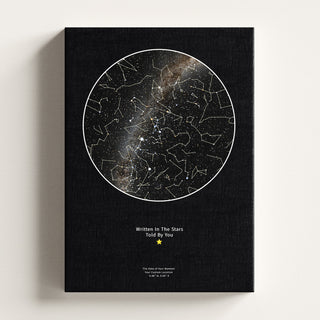
A personalised star map of the exact night you were out watching
A personalised star map from Skylit Studio recreates the real sky for a chosen date, time and place, calculated rather than illustrated. The astronomical precision behind our star maps means the arrangement on your wall is the arrangement that was overhead. What makes it yours is the moment you choose and the words you add beneath it.
If the spot you watched from matters as much as the sky did, a personalised location map of that hilltop, coast or back garden makes a natural companion piece. You can also read more about the science behind personalised moon phase prints, or see how it works from design to delivery.
Not sure what the sky looked like on a date that already matters to you? Start with our guide to seeing the night sky on a specific date and location, then turn the result into something you can hang.
Frequently Asked Questions
What astronomical events are left in 2026 in the UK?
The deep partial lunar eclipse on 28th August, Saturn at opposition in early October, the Orionid meteor shower on 21st-22nd October, the Leonids on 17th-18th November, a supermoon on 24th November, the Geminid meteor shower on 13th-14th December, the winter solstice on 21st December and the closest supermoon of the year on 24th December.
Can I see the 28 August 2026 lunar eclipse from the UK?
Yes, with the right horizon. Around 93% of the Moon enters the Earth's shadow, and the useful window is roughly 04:00 to 05:30 BST on Friday 28th August, with maximum at about 05:13. The Moon is low in the west-south-west and sets before the eclipse formally ends, so you need a clear, unobstructed view towards the west rather than dark skies.
Is there a planetary alignment in 2026?
The major one was in late February 2026, when six planets appeared across the evening sky at once. Nothing on that scale returns before the year ends. What remains is a steady run of conjunctions, where the Moon or two planets pass close together, which are easier to see and often more striking. Check the Night Sky Explorer for the exact night you are planning.
When are the next meteor showers in 2026?
The Orionids peak on 21st-22nd October, the Leonids on 17th-18th November and the Geminids on 13th-14th December. The Geminids are the strongest of the three and have the darkest skies this year, making them the best bet if you only go out once.
How many supermoons are left in 2026?
Two: 24th November and 24th December. The December one reaches full at 01:29 on the 24th, so the evening of the 23rd is the practical time to watch it rise. It is the closest full moon of 2026, so it appears the largest and brightest. A supermoon looks around 14% wider and up to 30% brighter than a full moon at its most distant point.
Do I need special equipment for the rest of 2026?
No. Meteor showers, supermoons and the lunar eclipse are all naked-eye events, and binoculars are the only upgrade most people ever need. A telescope helps for Saturn's rings around its October opposition. A red torch and warm clothing do more for your night than anything expensive.
Where can I get the full 2026 calendar to print?
Our 2026 UK celestial events calendar lists every date for the whole year and includes a free downloadable PDF you can print and pin up.
The Best of 2026 Is Still Ahead
The eclipse everyone talked about has passed, but the quieter half of the year is often the better one for actually standing outside. Longer nights, clearer air, a copper Moon at the end of August and a proper meteor shower a fortnight before Christmas.
Mark the dates. Take someone with you. And when a night turns out to be one you want to keep, the sky above it can be recreated exactly. Written in the stars. Told by you.
Try it yourself · Free
Curious to see the real night sky for yourself? Our free Night Sky Explorer is a live planetarium in your browser. Pick any date, time and place and the real stars, constellations, planets, Moon and Milky Way appear exactly as they were. Travel through time, tap any star to learn its story, then turn your moment into a print.
Open the Night Sky Explorer →


