


Somewhere in your memory there is a night you would love to see again. The evening you moved into your first flat, the night you met someone who changed everything, the day a new puppy came home, or a family date from long before you were born. The weather may be lost to time, but the Moon is not. Its phase on any date, past or future, can be worked out precisely, and it takes less than a minute to find.
This guide explains how to answer the question "what was the moon phase on a specific date?", how moon phase calculators reach their answer, what time and location actually change, and how to turn that exact Moon into something you can hang on a wall.
Why look up the moon on a specific date?
People search for the Moon on a particular night for all sorts of reasons. Some are sentimental: the night of a proposal, a grandparent's wedding decades ago, the first night in a new home, a graduation, or the evening a long-awaited phone call finally came. Others are pure curiosity. Historians check whether a battle was fought under moonlight, writers check whether the full moon in their novel is plausible, and plenty of us simply wonder what was hanging over the street on a date that mattered.
Whatever the reason, the answer is a real, checkable fact. The Moon's phase is not folklore or guesswork; it is geometry, and that geometry has been tracked with remarkable precision for centuries. If you have ever looked up the night sky on a specific date and location, think of this as the lunar companion to that search.
How moon phases work, in plain terms
The Moon makes no light of its own. At any moment, the Sun lights exactly half of it, the half facing the Sun. What changes from night to night is how much of that sunlit half is turned towards us on Earth.
As the Moon orbits Earth, the angle between the Sun, Earth and Moon shifts. When the Moon sits roughly between us and the Sun, its lit side faces away and we see a new moon. When it is on the far side of Earth from the Sun, the whole lit face points our way and we see a full moon. Everything in between produces the crescents, quarters and gibbous shapes.
One complete cycle from new moon to new moon is called a synodic month, or lunation, and it lasts about 29.53 days on average. Because the Moon's orbit is slightly elliptical and Earth is moving around the Sun at the same time, individual lunations vary, running from roughly 29.3 to 29.8 days. That small wobble is why a quick calculation can be a few hours out, and why proper calculators use detailed astronomical models instead of a single average.
✦
Every date has a moon. Its phase is simply the geometry of that night, waiting to be looked up.
The eight phases at a glance
Astronomers mark four principal phases, which happen at exact instants, and four intermediate phases that fill the days between. Here they are in order, as seen from the UK and the rest of the northern hemisphere:

- New moon: the lit side faces away from us. The Moon is up during the day, close to the Sun, and essentially invisible.
- Waxing crescent: a thin sliver appears on the right, visible low in the west after sunset.
- First quarter: the right half is lit. It is called a quarter because the Moon is a quarter of the way through its cycle, even though half of the disc is visible.
- Waxing gibbous: more than half lit and growing, prominent in the evening sky.
- Full moon: the whole face is lit. It rises around sunset and sets around sunrise, so it is up all night.
- Waning gibbous: still bright but shrinking, rising later each evening.
- Last quarter (also called third quarter): the left half is lit, rising around midnight and lingering into the morning.
- Waning crescent: a thin sliver on the left, best seen before dawn.
The principal phases arrive roughly a week apart, about 7.4 days on average. "Waxing" means growing towards full; "waning" means shrinking back towards new. For a longer tour of each shape and how to spot tonight's, Skylit Studio's guide to the science behind personalised moon phase prints goes into more depth.
How to work out the moon phase for any date
The fastest route is a moon phase calculator: you enter a date, and it returns the phase, the percentage of the disc that was lit, and usually the Moon's "age", meaning the number of days since the last new moon. Behind the scenes, good calculators use published astronomical ephemerides, the same kind of tables and models observatories rely on.

You can also get a surprisingly close answer with a pencil and a calculator. Here is the shortcut:
- Start from a known new moon. A common reference is the new moon of 6 January 2000 at 18:14 UTC.
- Count the days between that reference and your chosen date (count backwards for earlier dates).
- Divide by 29.53 to find how many lunar cycles have passed.
- Take the leftover fraction and multiply it by 29.53. That gives the Moon's approximate age in days.
An age near 0 means new moon, around 7.4 is first quarter, about 14.8 is full, around 22.1 is last quarter, and close to 29.5 brings you back to new.
A worked example: take the evening of 19 September 2015. That is about 5,735 days after the reference, or roughly 194.2 cycles. The leftover 0.2 of a cycle works out at about six days, which points to a waxing crescent. A precise ephemeris agrees: the new moon fell on 13 September 2015, so by that evening the Moon was about six and a half days old and roughly a third lit, with first quarter arriving two days later. The shortcut landed within half a day, which is plenty to name the phase, though it is not precise enough to pin down the exact hour of a full or new moon.
Do time and location change the answer?
This is where a little care pays off. The phase itself is a shared, planet-wide fact. At any single instant, the Moon is at one point in its cycle for everyone on Earth, and the percentage of the disc that is lit is effectively the same whether you are in Leeds or Lima. What time and place do affect is how and when you would have seen it.
- The calendar date can shift. Principal phases happen at precise moments. A full moon at 2am in London happened on the previous evening's date in New York, so a calculator set to a different time zone can appear to give a different day.
- Moonrise and moonset vary. Whether the Moon was above the horizon at 9pm on your chosen night depends on where you were. A full moon is up through the night, while a waning crescent may not rise until the small hours.
- Orientation depends on hemisphere. From Australia or South Africa, the Moon appears flipped compared with the UK: a waxing crescent is lit on the left, not the right. Near the equator, crescents often look tilted, like a bowl.
So if you want the full picture for a night, add the place to the date. The phase stays the same, but the place tells you whether it was rising over the rooftops or still waiting below the horizon. Skylit Studio's guide to what the sky looked like on a given date covers the stars and planets side of that same question.
Looking up dates from long ago
Moon phase calculations work just as well for 1925 as they do for last Tuesday. Lunar motion is understood so thoroughly that astronomers can compute phases for thousands of years in either direction, and historians use exactly these calculations to date old records.
Two practical tips for older dates. First, if your date comes from family memory, confirm it against a certificate, letter or newspaper before you rely on it, because a single day can move you from one phase to the next around a quarter. Second, if you are going back a very long way, remember that Britain switched from the Julian to the Gregorian calendar in September 1752. Dates recorded before then in Britain may need converting before a modern calculator gives the right answer.
Then there are the dates that are simply fun to check. Pick a moment from history, the Apollo 11 landing, the night your town's football club won the cup, or the evening a favourite album was released, and see which Moon was watching over it.
Make it personal
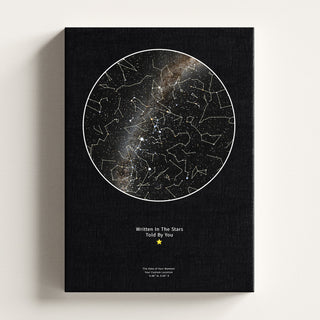
 Personalised Star Map | Custom Night Sky Print
From £21.99
View product →
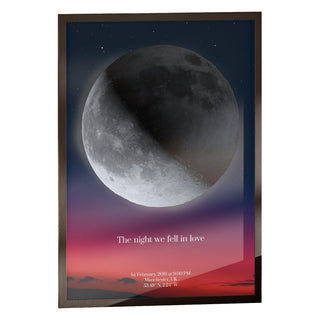
 Personalised Moon Map | by Skylit Studio
From £21.99
View product →
 Personalised Moon Phase Map for Family | by Skylit Studio
From £21.99
View product →
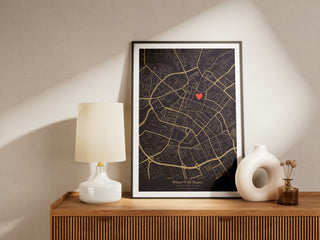
 Custom Location Map | Personalised Map Print by Skylit Studio
From £21.99
View product →
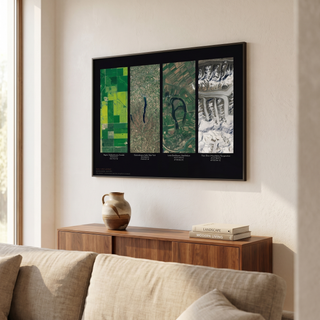
 Your Name From Orbit
From £21.99
View product →
 Print Your Universe - Custom Image Print
From £19.79
View product →
From lookup to print: keeping that night's moon
Once you know the phase, it is natural to want to keep it. That is what Skylit Studio's Personalised Moon Phase Print is built for. You choose the date and place in the customiser, and it renders the Moon accurately for that night as a piece of art. You then add your own words: a large personal message as the centrepiece, plus a short caption that sits above the printed date and location. You can preview the whole design before ordering, then pick a framed print, an unframed print or a canvas.

What makes the finished piece personal is the moment you chose and the words you set beside it. Maybe it is a crescent from the night a business opened its doors, a gibbous Moon from a first date, or a full moon from the evening a family gathered for a reunion. The same lookup you did above becomes the heart of the design.
If one date is not enough, the Family Moon Phase Print places several moons side by side, which suits a household of birthdays, a run of milestones, or the dates that link one generation to the next. And if the stars matter as much as the Moon, a personalised star map shows the full sky for the same date and place.
Not sure which date to choose when several feel important? Skylit Studio has a dedicated guide on how to choose a date for a moon phase print, and a complete buyer's guide to personalised moon phase prints covering finishes and frames. Planning one as a present for a particular celebration? The moon phase print gift guide has ideas, and how it works walks through the ordering steps.
Frequently asked questions
Is the moon phase the same everywhere on Earth?
Yes, at any given instant the Moon is at the same point in its cycle for the whole planet, and the proportion of its disc that is lit is effectively identical everywhere. Location changes when the Moon rises and sets, and which way up it appears, and time zones can shift the calendar date on which a principal phase falls.
How accurate is a moon phase calculator?
Calculators built on astronomical ephemerides are extremely precise, pinning principal phases down to the minute. The simple averaging shortcut described above usually names the phase correctly and lands within about a day of the true age, which is fine for curiosity but not for exact timings.
Can I find the moon phase for a date decades or centuries ago?
Yes. Lunar motion can be calculated reliably for thousands of years into the past. For British dates before September 1752, check whether the date was recorded in the old Julian calendar, as it may need converting first.
What if it was cloudy, or the Moon was not visible that night?
The phase does not depend on the weather. Clouds may have hidden the Moon, or it may have been below the horizon at the hour you remember, but it was still in a definite phase, and that is what a calculator, and a Skylit Studio Moon Phase Print, shows.
What sizes and prices does the Moon Phase Print come in?
Framed prints come in A4, 30x40cm, 40x50cm, 50x70cm and 60x80cm, with Black, White and Natural frames across the range and Dark Brown up to 40x50cm, from £36.98 to £119.98. Unframed prints run from £21.99 (A4) to £69.99 (60x80cm), and canvases from £49.99 (A4) to £99.99 (50x70cm).
How quickly is it dispatched, and how is it packed?
Orders placed by 3pm Monday to Friday are dispatched the same working day, though canvas may need one extra working day. UK delivery is free by Royal Mail Tracked 48 (2 to 4 business days), with paid next-day options available. Unframed A4 prints ship flat in a rigid mailer, larger unframed prints ship rolled in a cardboard tube, framed prints are wrapped and boxed, and canvases arrive boxed and ready to hang.
The Moon has been keeping time over every date you care about. Look it up, find the shape it made that night, and if it feels worth keeping, design your Moon Phase Print with Skylit Studio.


