


The impulse behind the question is a lovely one. Someone matters enormously to you, and pointing at the sky and saying that one is yours feels like the right size of gesture. So it is worth taking the question seriously rather than dismissing it: can you name a star after someone, and what do you actually receive if you try?
This is an honest UK explainer. We will cover who really has the authority to name stars, what a registry certificate is in practical terms, why the name never appears in any scientific catalogue, and what you can give instead if you want something a person can check for themselves. At Skylit Studio we print the real night sky, so we have a view here, but the facts below are simply the facts and you can verify every one of them independently.
The Short Answer
You can pay a company to record a name against a star in that company's own private database, and they will send you a certificate and a star chart. What you cannot do is give a star a name that astronomers, observatories, universities or space agencies will use. Those two things are often described in the same language, which is where the confusion comes from.
Nothing about that is a scandal. Plenty of people who buy a star naming gift understand exactly what it is and love it anyway, as a keepsake and a piece of symbolism. The problem only arises when someone believes they have bought something official and later discovers they have not. Knowing the difference before you buy means you can choose the gift you actually want.
Who Officially Names Stars
The naming of objects in space is handled by the International Astronomical Union, usually shortened to the IAU. It is the professional body that astronomers worldwide recognise as the authority on nomenclature, and within it a dedicated working group is responsible for star names specifically.
That group maintains a formal catalogue of approved proper names. It is a fairly short list by astronomical standards, containing a few hundred entries such as Sirius, Betelgeuse, Rigel, Vega and Polaris. Most of these names are centuries old and arrived through Arabic, Greek and Latin astronomical tradition rather than through any modern process. When a new proper name is approved, it goes through scholarly review, and it is not sold.
The same body defines the 88 official constellations and their boundaries, which is why any accurate sky chart in the world agrees on where one constellation ends and the next begins. We wrote a full explainer on that if you are curious about how the modern constellation system was standardised: what IAU constellations are and how they differ from zodiac signs.
Beyond that short list of proper names, the overwhelming majority of stars have no name at all. They have designations: strings such as HD 209458, Gliese 581 or TYC 3162-665-1, drawn from survey catalogues. There are billions of them, and a designation is a coordinate-and-catalogue reference rather than a name in any sentimental sense. If you enjoy the history of how the sky came to be charted and labelled, the Royal Observatory Greenwich is the natural place to start in the UK.
What a Star Registry Actually Sells
A star-naming registry is a private company. It picks a star from a published catalogue, records your chosen name against it in a database it owns and controls, and sends you a package: a certificate, usually a chart showing the star's position, sometimes a booklet, sometimes a framed presentation.
Everything in that package is genuine as an object. The certificate is a real certificate, the star exists, the coordinates are real coordinates. What the certificate is not is a registration with any external authority, because no such registration process exists for the public. The company is, in effect, publishing a book of names and selling you a line in it. Several such companies operate independently, which means the same star can carry different names in different private databases at the same time.
In practical terms you are buying a gift item and a printed document. Consumer protection rules apply to the transaction in the ordinary way, but there is no astronomical body standing behind the naming itself.
How Much Does It Cost to Name a Star?
UK prices vary widely by company and package. Entry-level digital certificates tend to sit at the low end of tens of pounds, mid-range framed packages run higher, and premium tiers promising brighter stars, faster delivery or added gift boxes can reach three figures. Brightness upgrades are a common upsell, since a brighter star is one the recipient might actually be able to find.
That last point is worth pausing on. Most catalogue stars available for naming are far too faint to see with the naked eye from a British garden, so even the finding-it-together moment often needs a telescope and clear conditions. If seeing the thing matters to you, check the magnitude before you buy.
A name is a promise about the future. A sky is a record of something that already happened.
Skylit StudioWhy the Name Never Reaches a Catalogue
Scientific catalogues are working tools. An astronomer pointing a telescope needs an identifier that unambiguously resolves to a set of coordinates, a brightness and a spectral type, cross-referenced across decades of observations. Names are added to that system only when there is a scholarly reason, through review, and with the aim of avoiding duplication.
Adding commercially sold names would break that. Two companies could sell the same star under two names, or one name could be sold repeatedly. So the professional literature simply does not import them, and a search of any research database for a privately registered name returns nothing. This is not an oversight or a snub. It is what keeps the catalogues usable.
The practical consequence for a gift is straightforward. There is no public record the recipient can look up years later that will independently confirm the name. Whatever value the gift has lives entirely in the certificate itself and in the feeling behind it.
Make it personal
 Personalised Star Map | Custom Night Sky Print
From £21.99
View product →
Personalised Star Map | Custom Night Sky Print
From £21.99
View product →
 Personalised Moon Map | by Skylit Studio
From £21.99
View product →
Personalised Moon Map | by Skylit Studio
From £21.99
View product →
 Personalised Moon Phase Map for Family | by Skylit Studio
From £21.99
View product →
Personalised Moon Phase Map for Family | by Skylit Studio
From £21.99
View product →
 Custom Location Map | Personalised Map Print by Skylit Studio
From £21.99
View product →
Custom Location Map | Personalised Map Print by Skylit Studio
From £21.99
View product →
 Your Name From Orbit
From £21.99
View product →
Your Name From Orbit
From £21.99
View product →
 Print Your Universe - Custom Image Print
From £19.79
View product →
Print Your Universe - Custom Image Print
From £19.79
View product →
A Verifiable Alternative: The Real Sky
Here is what we think is the genuinely satisfying substitution. Rather than buying a name that no astronomer recognises, print the sky itself: the actual arrangement of stars above a specific place, on a specific date, at a specific minute.
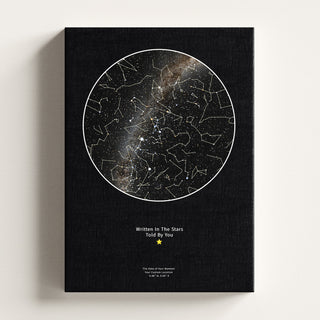
A personalised star map from Skylit Studio is computed, not decorated. You give a date, a time and a location, and the software works out which stars were above the horizon, where they sat relative to one another, and how the constellation lines and the Milky Way fell across that view. Every star on the print is a real star in a real catalogue position. The method is set out in full on our page about the astronomical precision behind our star maps.
The important word is verifiable. Anyone can take the date, time and place printed on the map, run it through planetarium software or an ephemeris, and get the same sky back. Nobody needs to trust a private database, because the answer is computable from first principles by anyone who cares to check. If you want to try it before ordering anything, our interactive night sky explorer lets you move through the sky yourself, and this guide walks through the idea in more depth: the night sky on a specific date and location.
Which moment you choose is the whole design decision. A birth night, the evening of a proposal, a wedding date, the day a family arrived in a new country, the last summer with someone. We collected some of the ways people approach that choice in what did the sky look like on this date.
If the Moon Is the Stronger Memory
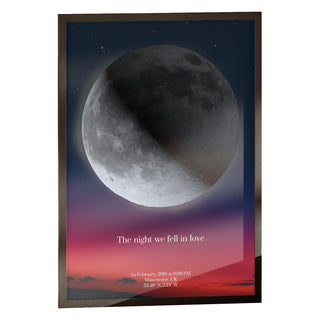
Some moments are remembered by the Moon rather than the stars: a full moon on a beach, a thin crescent over a hospital car park at four in the morning. A personalised moon map renders the Moon's exact phase and orientation for a chosen date and viewing location, calculated the same way. It is the same principle with a different subject.
What Actually Makes It Personal
What makes it theirs is the pairing. You chose that minute out of every minute there has ever been, because of what happened in it, and then you put your own words underneath. The custom text lines carry a name, a place, a date, or a sentence only the two of you understand. That combination is what turns astronomical data into something that belongs to a person, and it is honest in a way a naming certificate cannot be. One map holds one moment: a single date, a single time, a single place. It is not a claim of ownership over the sky, it is a record of a moment that mattered.
If you are working out what to write, our buyer's guide to personalising a custom star map covers the text lines, styles and layout choices in detail. And if you want the recipient to be able to go outside and actually find something they recognise on the print, the constellations visible from the UK is a good companion read.
Sizes, Prices and Ordering
Prints come in A4, 30 x 40 cm, 40 x 50 cm, 50 x 70 cm and 60 x 80 cm. Unframed prints start at £21.99 for A4 and rise to £69.99 for 60 x 80 cm. Framed options in black, white or natural oak engineered wood run from £36.98 to £119.98, with a dark brown frame also available at A4, and canvas starts at £49.99. That is the full range, and it is the same across our print lines.
Practical Details
- Dispatch: same working day if you order by 3pm, Monday to Friday, excluding UK public holidays (canvas items may need up to one extra working day)
- UK delivery: 2 to 4 working days after dispatch via Royal Mail Tracked 48, free as standard
- Packaging: unframed A4 ships flat in a rigid mailer; unframed 30 x 40 cm and larger are rolled in a sturdy tube; framed prints are wrapped and boxed
- Made in the UK: printed and finished in Manchester
The full ordering process, from entering the date to choosing a frame, is laid out on our how it works page, and you can read more about the studio on our about us page.
Frequently Asked Questions
Can you name a star after someone officially?
No. Only the International Astronomical Union approves star names, and it does not sell them or accept public submissions for commemorative naming. Any company offering to name a star is recording that name in its own private database.
Is a star registry certificate worth anything?
It has value as a keepsake and as a gesture, and many people are perfectly happy with theirs. It has no standing with astronomers, observatories or space agencies, and the name will not appear in any research catalogue. Buy it knowing that, and it can still be a lovely thing to receive.
How much does it cost to name a star in the UK?
Prices range from roughly the cost of a greetings-card-plus package at the entry level to well over £100 for premium framed bundles with brighter stars. Costs differ between companies, and brightness and framing are the usual upgrades.
Will the person be able to see their named star?
Often not with the naked eye. Most stars offered for naming are faint catalogue objects that need a telescope and dark skies. If visibility matters, check the star's magnitude first. For a sense of what is genuinely visible without equipment, see our guide to the night sky tonight from the UK.
How is a star map different from naming a star?
A star map is a record rather than a claim. It shows the real positions of real stars above a chosen place at a chosen minute, computed from astronomical data, so anyone can independently check it. Nothing is being assigned or registered, which means nothing can turn out to be unrecognised later.
Can I still give a star map at short notice?
Yes. Orders placed by 3pm on a working day are dispatched the same day (canvas items may need up to one extra working day), with UK delivery in 2 to 4 working days after that via tracked post. Expedited options are available at checkout if the date is tight.
A Gift That Holds Up to Checking
If you love the symbolism of naming a star after someone, there is nothing wrong with buying that certificate, as long as you know what it is. Symbolic gifts are real gifts. But if what you actually wanted was to hand someone a piece of the sky that stands up to scrutiny, the sky itself is available, free to compute and ready to print.
Pick the minute that mattered. Add the words. The stars in that print were genuinely there, exactly as shown, and they can be checked by anyone for as long as the print hangs on the wall. Written In The Stars. Told By You.
Browsing for someone in particular? Our complete UK star map gift guide works through occasions, sizes and finishes.


