




Every December, a star goes on top of millions of Christmas trees. It is one of the most familiar symbols of the season, and it points back to a single short passage written almost two thousand years ago: a bright light in the sky that guided travellers from the east to Bethlehem.
For centuries, astronomers have asked whether that light could have been something real: a meeting of planets, a comet, an exploding star, or a symbol never meant as an astronomical report. This guide explains the Christmas star meaning and the leading scientific theories. The honest headline first: nobody knows for certain what, if anything, the star was. The search, though, is wonderful astronomical detective work.
Christmas Star Meaning: Where the Story Comes From
The Star of Bethlehem appears in only one place: the second chapter of the Gospel of Matthew. Magi, usually understood as learned star-watchers from Persia or Babylonia, arrive in Jerusalem asking where the newborn king of the Jews can be found, because they have seen his star and come to honour him.
In Christian tradition, the Christmas star is a sign in the heavens announcing the birth of Jesus, and a light that leads people towards him. That is why it crowns the tree and sits above nativity scenes. For astronomers, the passage raises a different question: could a real event in the sky of around 2,000 years ago have inspired it?
What the Text Actually Says
Any attempt at Star of Bethlehem astronomy has to start with the clues, and there are only a handful.
The magi saw it "at its rising"
The Greek phrase often translated as "in the east" can also mean "at its rising". Some scholars read it as a technical sky-watching term for a planet reappearing at dawn after weeks hidden in the Sun's glare: a precise event, not just a direction.
Herod apparently did not notice it
King Herod has to ask the magi when the star appeared, which suggests something meaningful mainly to people who studied the sky closely, rather than a dazzling spectacle.
It "went before them" and "stood over" a place
This is the hardest detail for any natural explanation. Everything in the sky moves with the turning Earth and appears equally "above" places miles apart, so no star or planet can single out one house. Every astronomical theory has to read this part as poetic language.
The timing
Matthew sets the story under Herod the Great, who most historians believe died around 4 BC. That is why astronomers searching for the star tend to look at roughly 7 BC to 2 BC.
Theory 1: A Jupiter and Saturn Conjunction
The most famous candidate goes back to Johannes Kepler. In December 1603 he watched Jupiter and Saturn draw close together, and when a brilliant new star appeared in 1604, he wondered whether a similar event could explain the Star of Bethlehem.
Working backwards, Kepler found that Jupiter and Saturn had met in Pisces in 7 BC. Modern calculations confirm it was a rare triple conjunction: the two planets passed each other three times that year.
Why a triple conjunction happens
Jupiter and Saturn meet roughly every 20 years, usually passing once. Occasionally the meeting happens while Earth is overtaking both planets, making them appear to drift backwards against the stars. That apparent retrograde motion can make the pair pass each other three times in a single year.
Why it appeals to historians
The planets never came closer than about a degree apart, roughly twice the width of the full Moon, so they looked like two bright points rather than one blazing star. That fits Herod's apparent ignorance. To skilled astrologers, though, a repeated meeting of the two great planets could have carried enormous meaning, because Jupiter was widely linked with kingship.
Perhaps the most compelling candidate is not the brightest event, but the one that meant the most to the people who were watching.
Theory 2: A Comet
If you picture the Star of Bethlehem with a glowing tail, thank Giotto di Bondone. His Adoration of the Magi fresco, painted in Padua in the early 1300s, shows a comet above the stable, very probably inspired by Halley's Comet in 1301. Centuries later, the European Space Agency named its own Halley's Comet probe Giotto in his honour.
Halley's Comet returned in 12 BC, probably too early. A stronger candidate comes from Han dynasty records in China, which describe a new "broom star" in the spring of 5 BC, visible for more than 70 days. The physicist Colin Humphreys has argued this comet could be the star the magi followed.
Comets do shift position against the stars from night to night, so one could seem to travel. The problem is reputation: in the ancient world, comets were widely seen as omens of disaster, not heralds of a royal birth.
Theory 3: A Nova or Supernova
A nova happens when a white dwarf in a close pair of stars suddenly flares, brightening enormously for weeks or months. A supernova is the explosion of a whole star, which can outshine every other star for a time. A genuinely new star is exactly the kind of sign sky-watchers prized, and some researchers read the Chinese record of 5 BC as a nova, since it does not clearly mention movement or a tail.
The difficulty is evidence. A bright supernova would normally leave a debris cloud detectable today, and none has been convincingly matched to this period. A nova leaves less trace, which keeps the idea alive but impossible to confirm.
Make it personal
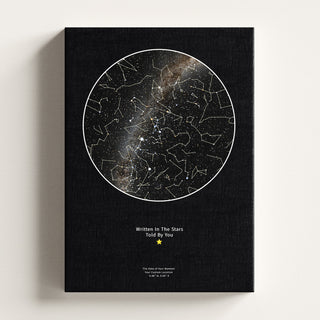
 Personalised Star Map | Custom Night Sky Print
From £21.99
View product →
Personalised Star Map | Custom Night Sky Print
From £21.99
View product →
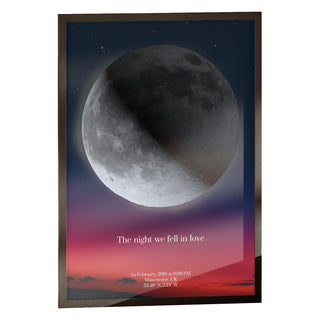
 Personalised Moon Map | by Skylit Studio
From £21.99
View product →
Personalised Moon Map | by Skylit Studio
From £21.99
View product →
 Personalised Moon Phase Map for Family | by Skylit Studio
From £21.99
View product →
Personalised Moon Phase Map for Family | by Skylit Studio
From £21.99
View product →
 Custom Location Map | Personalised Map Print by Skylit Studio
From £21.99
View product →
Custom Location Map | Personalised Map Print by Skylit Studio
From £21.99
View product →
 Your Name From Orbit
From £21.99
View product →
Your Name From Orbit
From £21.99
View product →
 Print Your Universe - Custom Image Print
From £19.79
View product →
Print Your Universe - Custom Image Print
From £19.79
View product →
Other Astronomical Ideas
Astronomers have proposed several other events from the same years:
- Jupiter and the Moon in 6 BC. The astronomer Michael Molnar has argued that the Moon passed in front of Jupiter in the constellation of Aries in April 6 BC, an event an ancient astrologer might have read as a royal sign.
- Jupiter and Regulus in 3 to 2 BC. Jupiter made a series of close passes by Regulus, the bright "king star" in Leo, then met Venus very closely in June 2 BC. These fit if Herod died a little later than usually thought.
Planetary positions can be calculated backwards with great precision, which is why each theory can be tested against the sky of the time. If you are curious how those calculations work, our guide to how the real night sky is calculated explains the method in plain English.
Theory 4: A Symbol Rather Than an Object
Many biblical scholars think the question may be the wrong one. Ancient writers often marked great births with signs in the heavens, and Matthew's audience knew the line from the Book of Numbers: "a star shall come out of Jacob".
On this reading, the star is a theological statement in the language of the sky. That does not rule out a real event behind it: a remembered conjunction could easily have been woven into a story whose purpose was meaning rather than measurement.
So, What Was the Star of Bethlehem?
The honest answer to "what was the Star of Bethlehem?" is that we do not know, and probably never will. The Christmas star astronomy theories in brief:
The leading theories at a glance
Conjunction (7 BC): real and calculable, but never looked like a single star.
Comet (5 BC): recorded and moving, but comets were bad omens.
Nova: fits the story, but leaves no confirmed trace.
Symbol: fits the text's purpose, alongside any of the others.
What the search has shown is rather lovely: people two thousand years ago watched the sky closely enough for a subtle meeting of planets to change their lives, and we can still recreate the sky they saw.

The Modern "Christmas Star"
On 21 December 2020, Jupiter and Saturn appeared just a tenth of a degree apart, closer than at any time since 1623. Four days before Christmas, the pairing was nicknamed the "Christmas Star", and people across the UK went out to see it low in the south-west after sunset. The next such conjunction falls in 2040.
On many winter nights, the most brilliant "star" is actually Venus or Jupiter. Our 60-second guide to identifying that bright star will help you tell which is which, and the 2026 planet parade guide covers where the planets sit this year.
To see the sky for any date and place, from Christmas Eve over your home town to a birthday decades ago, try our interactive Night Sky Explorer.
Capturing the Sky on a Night That Matters
The story of the Christmas star is, at heart, about people looking up on a night that mattered and remembering what they saw. That instinct is just as strong today: the night a child was born, a wedding evening, the first Christmas in a new home.

At Skylit Studio, every personalised star map is calculated for the exact date, time and location you choose, using the same kind of astronomical calculation that lets researchers rebuild the sky of 7 BC. Our explainer on what a star map is and how the real night sky becomes a print covers the process, and the page on the astronomical precision behind our star maps goes into the detail.
The meaning of the print comes from the moment you pick and the words you add. Still deciding on a night? Our guide to the night sky on a specific date and location is a good place to start. If it is the Moon that marks your moment, a personalised moon map shows its exact phase on your chosen date.
Prints start at £21.99 for an unframed A4, with framed versions from £36.98, and orders placed by 3pm on a working day are dispatched the same day. Written In The Stars. Told By You.
Frequently Asked Questions
What is the Christmas star meaning?
In Christian tradition, the Christmas star represents the Star of Bethlehem from the Gospel of Matthew, a sign in the sky announcing the birth of Jesus and guiding the magi to him. That is why a star is placed on top of Christmas trees and above nativity scenes.
What was the Star of Bethlehem, scientifically?
Nobody knows for certain. The leading ideas are a triple conjunction of Jupiter and Saturn in 7 BC, a comet or new star recorded by Chinese astronomers in 5 BC, and a nova. Many scholars also read the star as a symbol rather than a literal object.
Was the Star of Bethlehem a comet?
Possibly. Chinese records describe an object visible for more than 70 days in 5 BC, which some researchers interpret as a comet. Against the idea, comets were usually seen as omens of disaster.
What is a Jupiter and Saturn conjunction?
A conjunction is when two planets appear close together in our sky, though they are hundreds of millions of kilometres apart. Jupiter and Saturn line up roughly every 20 years; in 7 BC they did so three times in one year.
When was the last "Christmas Star"?
On 21 December 2020, Jupiter and Saturn appeared just a tenth of a degree apart, their closest apparent meeting since 1623. It was widely nicknamed the Christmas Star. The next Jupiter and Saturn conjunction takes place in 2040.
Can I see what the sky looked like on a past Christmas?
Yes. Skylit Studio's free Night Sky Explorer shows the stars and constellations for any date and location, and a personalised star map prints the real sky for the exact date, time and place you choose.
Whatever the magi saw, the urge that sent them travelling is easy to recognise: a night in the sky too important to forget. This Christmas, step outside, look up, and notice which bright lights are keeping you company.


