



Most meteor showers are over in a flash, both literally and on the calendar. The Taurids are different. They trickle through the autumn sky for weeks, the meteors drift rather than dart, and now and then one flares into a fireball bright enough to light up the garden. The Taurid meteor shower in the UK reaches its best in early to mid November, and in 2026 the Moon is almost entirely out of the way.
Below are the 2026 peak dates for both branches, the Moon conditions we calculated for London, Manchester and Edinburgh, where to look, and why this modest shower is famous for fireballs.
The Short Answer
Taurids 2026 at a glance
Southern Taurids: active from mid September to about 20 November, with a broad maximum. Aim for the night of Wednesday 4 to Thursday 5 November.
Northern Taurids: active from about 20 October to 10 December. Peak around the night of Wednesday 11 to Thursday 12 November.
Moon: a thin waning crescent that rises around 02:40 GMT on 5 November; no Moon at all in the dark sky on 11 to 12 November.
Best time from the UK: from about 21:00 GMT, with the radiant highest around midnight to 01:00.
Where to look: east to south-east in the evening, due south around midnight, about halfway up the sky.
Rates: around 5 meteors an hour from each branch at a dark site, with a higher than usual share of fireballs.
Parent comet: 2P/Encke.
What Are the Taurids?
The Taurids are debris from Comet 2P/Encke, a small comet that loops around the Sun every 3.3 years, one of the shortest orbits of any known comet. Over thousands of years its dust and rubble have spread into a wide, diffuse stream. Encke and the stream are thought to be the remains of a much larger comet that broke apart over the last 20,000 to 30,000 years.

Because the stream is so spread out, the Earth spends weeks passing through it, so the Taurids offer a low, steady trickle of meteors rather than one sharp peak.
The shower is named after Taurus, the bull, where the meteors appear to come from. If you want to learn the shape of Taurus before the night, our guide to the zodiac constellations and where to find them in the UK sky is a good place to start.
Two Branches, Two Peaks
The gravity of the planets has pulled the stream into two overlapping branches.
Southern Taurids
The Southern Taurids are the broader branch. They run from mid September to around 20 November, and their maximum is a long, gentle plateau rather than a single night. That is why published dates vary: some calendars list the maximum as early as 10 October, while others place it around 4 to 5 November. Both are fair, because rates barely change across that stretch. For 2026, the night of 4 to 5 November is a good one to aim for: both branches are active and the Moon is only a thin crescent.
Northern Taurids
The Northern Taurids run from about 20 October to 10 December and peak around 11 to 12 November. Their radiant sits a little further north in Taurus.
The overlap is the useful part. On any clear night in the first half of November, both branches are active at once. For every other shower, eclipse and planet highlight this year, see our 2026 astronomical events calendar.
The Moon in November 2026
The Moon reaches last quarter at 20:28 GMT on 1 November and new moon at 07:02 GMT on 9 November. On the Southern Taurid night of 4 to 5 November it is a waning crescent, only about a fifth lit, and it does not rise until the early hours. By the Northern Taurid peak on 11 to 12 November, the Moon is a slender evening crescent just two to three days old. It sets in the early evening, before the sky is properly dark, and stays down all night.
| City | Fully dark (4 Nov) | Moonrise (5 Nov) | Dark sky ends (5 Nov) |
|---|---|---|---|
| London | 18:22 | 02:37 | 05:07 |
| Manchester | 18:30 | 02:46 | 05:16 |
| Edinburgh | 18:33 | 02:50 | 05:20 |
All times are GMT, since the clocks went back on 25 October. Our guide to the clocks going back in 2026 explains the change. "Fully dark" and "dark sky ends" mark the end and start of astronomical twilight; our explainer on when it gets dark in the UK covers what those terms mean.
Two peaks. One new moon between them. A dark November sky for both.
Best Time to See the Taurids
The best time to see the Taurid meteor shower from the UK is from about 21:00 GMT until the small hours. Taurus rises in the east-north-east as darkness falls, climbs through the evening, and reaches its highest point in the south at around 00:30 to 01:00 GMT, roughly 50 to 60 degrees up. The higher the radiant, the more meteors you see.
On 4 to 5 November, the window runs from about 21:00 until moonrise at around 02:40, and even then the crescent is faint and low. On 11 to 12 November you can watch from mid evening until dawn twilight.
That makes the Taurids a genuinely good evening shower, and a friendly one for families. Children can catch a slow fireball at 21:30 and still be in bed at a sensible hour.
Where to Look: Taurus and the Pleiades
The two Taurid radiants sit in Taurus, close to two of the easiest landmarks in the winter sky. The first is the Pleiades, the Seven Sisters, a small, misty cluster of stars that looks like a tiny dipper. The second is Aldebaran, the bright orange star that marks the bull's eye. Both radiants lie in the area around and just below the Pleiades, towards Aldebaran.
Taurids can appear anywhere in the sky; they simply trace back to Taurus. Face east to south-east in the evening, turning south around midnight, and rest your gaze about halfway up.
To see exactly where Taurus will be from your own town, open the free Night Sky Explorer, set your location, choose 4 or 11 November 2026 at 23:00 and look south-east.
Make it personal
 Personalised Star Map | Custom Night Sky Print
From £21.99
View product →
Personalised Star Map | Custom Night Sky Print
From £21.99
View product →
 Personalised Moon Map | by Skylit Studio
From £21.99
View product →
Personalised Moon Map | by Skylit Studio
From £21.99
View product →
 Personalised Moon Phase Map for Family | by Skylit Studio
From £21.99
View product →
Personalised Moon Phase Map for Family | by Skylit Studio
From £21.99
View product →
 Custom Location Map | Personalised Map Print by Skylit Studio
From £21.99
View product →
Custom Location Map | Personalised Map Print by Skylit Studio
From £21.99
View product →
 Your Name From Orbit
From £21.99
View product →
Your Name From Orbit
From £21.99
View product →
 Print Your Universe - Custom Image Print
From £19.79
View product →
Print Your Universe - Custom Image Print
From £19.79
View product →
Why the Taurids Are Known for Fireballs
A fireball is a meteor brighter than the brightest planets, and the Taurids produce more than their numbers suggest.
First, the stream contains larger pieces than most. Comet Encke has shed pebbles and small rocks, not just sand-sized grains, and the bigger the particle, the brighter the meteor. Second, Taurids are slow, meeting the Earth at around 27 kilometres per second, less than half the speed of the Orionids or Leonids. Slow meteors last longer, often a second or two, and are easy to follow. That is where the old nickname "Halloween fireballs" comes from.
Swarm years
Part of the stream is held in a denser swarm by Jupiter's gravity, and the Earth meets it only every few years. Swarm years such as 2005 and 2015 brought bursts of bright fireballs. 2026 is not a predicted swarm year, but a normal season still delivers the occasional fireball.
How to Watch From the UK
Find the darkest sky you can
The Taurids are a naked-eye shower, so leave the telescope at home. With only a few meteors an hour, darkness matters. A back garden with the house lights off works. A rural spot away from streetlights works better.
Watch out for Bonfire Night
The Southern Taurid night runs into 5 November. Firework smoke and haze can spoil the sky near towns, so watch on the 4th or head well away from displays.
Dark eyes, warm layers
Allow 20 minutes for your eyes to adapt, and keep your phone dimmed right down. A reclining chair or camping mat helps, and November nights can drop close to freezing, so bring a blanket, a hat and a hot drink.
Give it an hour
Treat any Taurid as a bonus while you enjoy the Pleiades, Orion rising in the east and the rest of the autumn sky. For a wider tour, see what you can see in the UK night sky with no equipment.
How the Taurids Compare
The Taurids sit between two livelier autumn showers. The Orionid meteor shower peaks in late October with faster, more frequent meteors. The Leonid meteor shower follows on 17 to 18 November with some of the fastest meteors of the year. Compared with the summer's Perseid meteor shower, the Taurids offer far fewer meteors an hour.
What they offer instead is character: weeks of activity, good evening viewing and a real chance of a fireball.
Keeping the Night
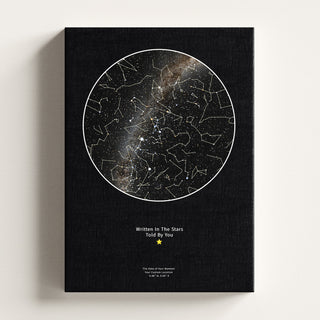
A fireball tends to stay with people, especially when it is shared: a child's gasp in the back garden, or two of you on a cold hillside when the whole sky lights up for a second. If that night means something, a personalised star map from Skylit Studio shows the real sky above your chosen place at that exact date and time, with Taurus, the Pleiades and Orion drawn where they actually stood. Add a line of your own words, and the print becomes your record of that night.

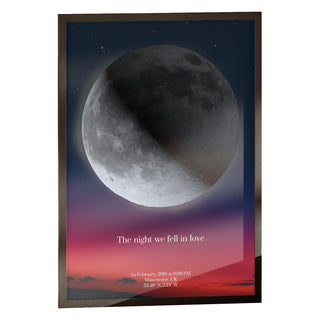
The Moon is the other half of the story. On the Southern Taurid night it was a thin waning crescent rising before dawn; on the Northern peak it was a fresh crescent only a couple of days old. A personalised moon phase print shows the Moon exactly as it appeared on your chosen date, which suits a night when the Moon stepped aside to let the meteors through. You can browse the full range of moon phase prints too.
Both prints come in A4, 30 x 40 cm, 40 x 50 cm, 50 x 70 cm and 60 x 80 cm, from £21.99 unframed up to £119.98 for the largest framed size, with canvas also available. Written In The Stars. Told By You.
Frequently Asked Questions
When is the Taurid meteor shower in the UK in 2026?
The Taurids are active from mid September to early December. The Southern Taurids have a broad maximum; aim for the night of 4 to 5 November 2026. The Northern Taurids peak around the night of 11 to 12 November 2026. Any clear night in the first half of November gives you both branches at once.
What is the best time to see the Taurid meteor shower?
From about 21:00 GMT until the small hours, with the radiant highest in the south at around midnight to 01:00. On 4 to 5 November the crescent Moon rises around 02:40; on 11 to 12 November there is no Moon in the dark sky at all.
Will the Moon affect the Taurids in 2026?
Very little. New moon falls on 9 November 2026, between the two peaks. The Southern Taurid night has only a thin crescent rising in the early hours, and on the Northern Taurid night the Moon sets before the sky is fully dark.
How many Taurid meteors will I see?
Around 5 an hour from each branch at a genuinely dark site, so perhaps up to 10 an hour in early November when both are active. From a town you will see fewer. The appeal is quality rather than quantity.
Are the Taurids fireballs?
Not all of them, but the Taurids are known for producing fireballs because the stream contains larger particles than most showers and the meteors are slow. That is why they are sometimes called the Halloween fireballs. 2026 is not a predicted swarm year, so expect a normal season with the occasional bright one.
Can I get a print of the sky on the night I watched the Taurids?
Yes. A personalised star map from Skylit Studio shows the real sky over any place at any date and time, and a personalised moon phase print shows the Moon as it appeared that night.
Slow Meteors, Long Nights
The Taurids reward patience. Pick a clear night in early November, find somewhere dark, wrap up warm and look south-east. You might wait twenty minutes for a single meteor. Then one drifts across half the sky, glowing orange, and the wait feels worth it. With a new moon between the two peaks, 2026 gives the Taurids a clean run.


