


There is one Sunday every autumn when the whole country gets an hour back in bed and loses the evening light in the same breath. If you have arrived here to check a date, here it is straight away: in the UK the clocks go back in 2026 on Sunday 25 October.
That is the answer to the lookup. The rest of this piece is the more useful part: what the change actually does, why it is not really about the sky at all, and why the weeks that follow are genuinely the best stretch of the year for standing in a British garden and looking up.
When Do the Clocks Go Back in 2026 in the UK?
The clocks go back on Sunday 25 October 2026. At 2am British Summer Time, clocks are turned back one hour to 1am, and Greenwich Mean Time resumes for the winter. You gain an hour of sleep, and sunset moves an hour earlier by the clock from that evening onwards.
The reason the date shifts year to year is that the rule is written as a weekday, not a number. The change always falls on the last Sunday in October. In 2026, 31 October is a Saturday, so the last Sunday of the month lands on the 25th.
The Clock Change at a Glance
- Date: Sunday 25 October 2026
- Time: 2am becomes 1am
- Direction: back one hour, so an extra hour in bed
- What ends: British Summer Time (BST)
- What resumes: Greenwich Mean Time (GMT)
- Next change: forward again on Sunday 28 March 2027
Phones, laptops and smart speakers handle it themselves overnight. The things that catch people out are the oven, the car dashboard, the boiler timer and any analogue watch or wall clock, so it is worth a five minute walk round the house on the Sunday morning.
British Summer Time, GMT and Why the Date Moves
British Summer Time runs from the last Sunday in March to the last Sunday in October. In 2026 that means BST began on Sunday 29 March and ends on Sunday 25 October. Looking further ahead, the clocks go forward on Sunday 28 March 2027 and back again on Sunday 31 October 2027.
GMT is the baseline the UK returns to for the winter, and it is also the reference the world's time zones are counted out from, a thread that runs back to the meridian at the Royal Observatory Greenwich. Nothing about the Earth changes at 2am on the 25th. We simply stop borrowing an hour of morning light and hand it back.
The clocks going back does not darken the sky. It moves the darkness into the hours you are actually awake for.
Skylit StudioWhat Actually Changes in the Sky
It is worth being accurate here, because the internet is not. No extra stars appear on 25 October. The night sky was always going to get darker earlier through autumn, because the Earth's tilt is carrying the northern hemisphere away from the Sun. That process is gradual and it started back at the autumn equinox in September.
What the clock change does is relabel the evening. On Saturday 24 October the sun sets somewhere around a quarter to six, depending on how far north and west you are. On Sunday 25 October the same sunset reads as roughly a quarter to five. By early November, true darkness has arrived across much of the UK well before 7pm.
That single hour is the whole story. Instead of proper darkness turning up at eleven at night in July, when most of us have given up, it turns up during ordinary evening hours: after work, after dinner, before the children go to bed. For anyone who has ever meant to take up stargazing and never quite got round to it, this is the change that makes it practical.

Why Darker Evenings Are the Best Stargazing Season in Britain
Late autumn and winter are the strongest naked-eye months in the UK, and there are a few real reasons for it.
The viewing window opens up
The nights are simply longer. From late October through to January you can get a full dark sky session in and still be indoors with a hot drink by nine o'clock, which is the difference between an occasional novelty and a habit.
Cold air is often clearer air
The crisp, dry air that follows a cold front through Britain tends to bring the steadiest and most transparent nights of the year. They are not frequent, this is still the UK and cloud wins plenty of evenings, but when a clear cold night does land in November or December, it is usually a very good one.
The winter constellations are the famous ones
This is the half of the year when the sky puts its best-known shapes on show. Orion, Taurus, the Pleiades and the bright winter stars are all coming into view, and they are bright enough to cut through a fair bit of suburban light pollution. If you want a sense of what is overhead before you go outside, our interactive night sky explorer lets you scan the sky from a screen first, and our guide to what you can see tonight with no equipment is a good starting list.
What to Look For Once the Clocks Have Changed
None of the following needs a telescope. Give your eyes twenty minutes away from phone screens and porch lights and the difference is dramatic.
An Easy Autumn and Winter Checklist
- Orion. Rising in the east late in the evening through late October and November, and comfortably up in the early evening by midwinter. Find the three belt stars, then orange Betelgeuse and blue-white Rigel either side.
- The Orion Nebula. The fuzzy patch hanging below the belt. It is a star-forming region, and it looks like a smudge of breath on glass to the naked eye.
- The Pleiades. A tight little knot of stars in Taurus, high in the evening sky through winter. Most people count six without optics.
- The Plough and Cassiopeia. Both circle the pole all year, and between them they point you to Polaris.
- The Andromeda Galaxy. High overhead on autumn evenings, and visible as a faint oval from a properly dark site.
- The Moon. The most reliable target there is. A first quarter moon shows the most relief, because the shadows along the day and night line throw the craters into contrast.
- The Geminid meteors. Mid December, and typically the most dependable shower of the year from the UK.
Wrap up warmer than feels necessary, take a seat outside rather than standing, and let your eyes adapt. Cold and impatience ruin more stargazing sessions in Britain than cloud does.
Make it personal
 Personalised Star Map | Custom Night Sky Print
From £21.99
View product →
Personalised Star Map | Custom Night Sky Print
From £21.99
View product →
 Personalised Moon Map | by Skylit Studio
From £21.99
View product →
Personalised Moon Map | by Skylit Studio
From £21.99
View product →
 Personalised Moon Phase Map for Family | by Skylit Studio
From £21.99
View product →
Personalised Moon Phase Map for Family | by Skylit Studio
From £21.99
View product →
 Custom Location Map | Personalised Map Print by Skylit Studio
From £21.99
View product →
Custom Location Map | Personalised Map Print by Skylit Studio
From £21.99
View product →
 Your Name From Orbit
From £21.99
View product →
Your Name From Orbit
From £21.99
View product →
 Print Your Universe - Custom Image Print
From £19.79
View product →
Print Your Universe - Custom Image Print
From £19.79
View product →
Keeping One of Those Nights
There is a natural next step once you have started paying attention to the sky in the evenings, and it is the reason Skylit Studio exists. A night that mattered to you can be drawn exactly as it was.

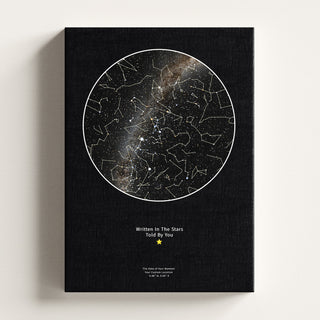
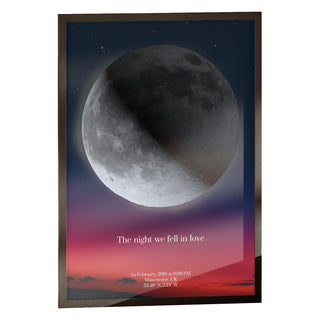
A personalised star map plots the real positions of the stars for a date, a time and a place you choose. A custom moon phase print does the same for the Moon, showing the exact phase it wore that night. If you want to see the range first, the whole moon phase print collection is worth a browse, and the astronomical precision behind our star maps explains how the positions are calculated rather than approximated.
What makes one of these prints yours is not the astronomy, it is the choice. You pick the night, and you write the line that goes underneath it. The evening you got engaged in the back garden, the night your daughter was born, the first clear night you ever properly looked up. If you are not sure which date to pick, our piece on the night sky on a specific date and location is a good way to think it through.
Choose the night that meant something, then say why underneath it. That pairing is the part nobody else has.
Skytalk, Skylit StudioOrdering Calmly, Before December
Late October has a quiet practical advantage. At Skylit Studio, personalised prints are typically printed and ready for dispatch the same working day, and orders placed by 3PM Monday to Friday, excluding UK public holidays, go out that day. UK delivery is free via Royal Mail Tracked 48, which arrives 2 to 4 working days after dispatch.
So speed is not the reason to order early. The reason is calm. Ordering in late autumn means you have time to settle on the right date, choose the wording of the message, and decide on a frame without doing all of that in a rush in the third week of December. Our how it works page walks through the process end to end, and if you are shopping for a parent, our guide to personalised Christmas gifts for mum covers the same ground from a gifting angle.
A personalised print sits happily alongside the classics rather than replacing them. Chocolates, a good candle, a bottle she actually likes: those are lovely, and they do a job on the day. A star map does a slightly different job, which is to still be on the wall in March. The two together often make a better gift than either alone.
Sizes, Frames and How It Arrives
Prints are available in A4, 30 x 40 cm, 40 x 50 cm, 50 x 70 cm and 60 x 80 cm. Unframed prints start at £21.99 for A4, and framed prints start at £36.98 for A4. Our engineered wood frames come in Black, White and Natural across the range, with Dark Brown available in A4 and 30 x 40 cm.

Packaging depends on what you order. An unframed A4 print is shipped flat in a rigid cardboard mailer. Unframed prints at 30 x 40 cm and larger are rolled and sent in a sturdy cardboard tube. Framed prints are wrapped in protective materials and boxed, and canvas prints arrive boxed and ready to hang with no frame needed.
If it is a gift, you can add gift wrapping and a gift note. The gift message is typed by you at checkout and printed on a card, with a choice of Editorial or Minimal card design and a Classic or Handwritten font style, so it goes in the box already written rather than needing anything from you on arrival.
Sunday 25 October 2026 is not the night the stars come out. It is the night the country stops pretending it is still summer, and the sky finally becomes something you can watch at a reasonable hour. Written In The Stars. Told By You.
Capture Your Moment in the Stars
Frequently Asked Questions
When exactly do the clocks go back in 2026 in the UK?
The clocks go back on Sunday 25 October 2026. At 2am British Summer Time the clocks move back one hour to 1am, and GMT resumes. The UK clock change always falls on the last Sunday in October, which in 2026 is the 25th.
Do we gain or lose an hour when the clocks go back?
You gain an hour. The night of Saturday 24 into Sunday 25 October 2026 is effectively 25 hours long, so there is an extra hour in bed. The trade-off is that sunset then reads roughly an hour earlier for the rest of the winter.
Does British Summer Time end in October 2026?
Yes. British Summer Time ran from Sunday 29 March 2026 and ends on Sunday 25 October 2026, when Greenwich Mean Time resumes. The clocks go forward again on Sunday 28 March 2027.
Do darker evenings mean you can see more stars?
Not more stars, no. The clock change does not alter the sky at all. What it does is move true darkness into normal evening hours, so you get a far longer usable window to look up before bedtime. Combined with longer autumn and winter nights and the arrival of bright constellations like Orion, that makes it the most practical stargazing season of the UK year.
Is autumn a sensible time to order a personalised print for Christmas?
It is, mainly because it is unhurried. Orders placed by 3PM Monday to Friday are typically dispatched the same working day, with free UK delivery via Royal Mail Tracked 48 arriving 2 to 4 working days after dispatch, so it is quick either way. Ordering in late autumn just gives you room to choose the right date and wording without rushing.
What size and frame should I choose?
A4 is a good fit for a desk, a shelf or a smaller wall, and framed A4 starts at £36.98. For a living room or a hallway where the print is the focal point, 40 x 50 cm or 50 x 70 cm carries the detail better. Black suits modern interiors, Natural warms up neutral walls, White disappears into pale ones, and Dark Brown is available in A4 and 30 x 40 cm.
Can a star map show the sky from my own town?
Yes. A star map is calculated for the specific date, time and place you enter, so the sky is plotted as it appeared from that location rather than from a generic viewpoint. You can preview how the sky looked for a given moment using our night sky explorer before you decide on the date.


