



Every few months an image does the rounds online: seven planets strung across the sky in a neat diagonal row, each the size of a dinner plate, hanging over a silhouetted hillside. It is a lovely picture. It is also a painting. The real thing is subtler and, honestly, better, because you can walk outside tonight and actually see it.
A planetary alignment in 2026 means several planets happen to sit in the same broad stretch of sky at the same time, close enough together that you can take them all in from one spot in the garden, and that is worth setting an alarm for. This guide covers what genuinely happens in UK skies through the rest of 2026: which direction to face, roughly what time to be out there, which planets you can see with nothing at all, and the ten-second trick for telling a planet from a star.
What a Planetary Alignment Actually Is
Astronomers use the word loosely. It means a handful of planets are gathered in the same general region of sky as seen from Earth, often spread across 60 to 100 degrees. It does not mean they form a straight line in space, or line up like beads on a string when you look up. There is a good reason they cluster at all: every major planet orbits the Sun in roughly the same flat plane, so from our position inside that plane they always appear along the same arc across our sky, the ecliptic, the same path the Sun and Moon follow. Planets never stray far from it, they simply slide along it at different speeds, and every so often several bunch up in the same stretch.
A planet parade is not a rare cosmic event. It is a rare cosmic viewing angle.
Skylit StudioThat shared arc is also why alignments get tangled up with astrology: the constellations the planets drift through are just background scenery from our vantage point, and the official boundaries astronomers work with are not the same thing as the twelve zodiac signs (we unpack that difference in our guide to how IAU constellations differ from zodiac signs). So when a headline promises a rare planetary alignment in 2026, read it as this: several planets are above the horizon at once, in the same part of the sky, for a week or two. Genuinely lovely, and genuinely worth stepping outside for.
The 2026 Planet Parades So Far
This year has already delivered two of them, which tells you something about how rare they really are.
28 February 2026: six planets after sunset
Mercury, Venus, Saturn, Jupiter, Uranus and Neptune were all above the horizon together in the western evening sky. Four of those, Mercury, Venus, Saturn and Jupiter, were bright enough to see with nothing but your eyes.
12 August 2026: six planets before dawn
The August gathering flipped to the morning side, with the same six planets spread across the pre-dawn east. Mars and Saturn were the easy ones, Jupiter and Mercury sat very low in brightening twilight, and it happened to share a date with something Britain had waited a long time for: the deepest partial solar eclipse over the UK since 1999.
If you like having the whole year mapped in advance, our 2026 UK celestial events calendar sets these alongside the eclipses, meteor showers and solstices, and the companion post on 2026 astronomical events you will not want to miss goes deeper on each one.
The Planets for the Rest of 2026
Here is where each naked-eye planet sits between now and the end of the year, from UK latitudes. Treat the times as approximate: the further north you are, the longer summer twilight lingers and the shorter your properly dark window.
Late August: Venus at its best in the west
Venus reaches its greatest separation from the Sun in our evening sky on 15 August, around 46 degrees away from it. Face west about 30 to 45 minutes after sunset and it is impossible to miss: brilliant, hard white, perfectly steady, brighter than anything else up there, and it holds up well for several weeks either side of the date. Then on 28 August the Moon takes its turn, with roughly 90 per cent of it sliding into Earth's shadow in the early hours. We have the full UK timings in our guide to the 28 August lunar eclipse.
October: Saturn's night, and Mercury's brief window
Saturn reaches opposition on 4 October, meaning Earth passes directly between Saturn and the Sun. It rises at sunset, sets at sunrise, and is at its brightest and closest for the year: any small telescope will show the rings, and even steady binoculars make it look distinctly non-circular rather than star-like. Mercury makes its best evening showing of the autumn around 12 October, sitting about 20 degrees from the Sun, though it is the hardest naked-eye planet to catch and rewards a flat western horizon and a clear evening. Venus, meanwhile, sinks away through October and passes between Earth and the Sun on 24 October, dropping out of the sky entirely for a few weeks around that point.
November and December: the action moves to the morning
Venus climbs back out as a morning object through November and December, gaining height in the pre-dawn east week by week alongside Mars and Jupiter. Saturn, having had its October night, sits high in the evening south instead. By the closing weeks of the year the pre-dawn east is the busy half of the sky, and the Geminid meteor shower peaks on 14 December for good measure.
Make it personal
 Personalised Star Map | Custom Night Sky Print
From £21.99
View product →
Personalised Star Map | Custom Night Sky Print
From £21.99
View product →
 Personalised Moon Map | by Skylit Studio
From £21.99
View product →
Personalised Moon Map | by Skylit Studio
From £21.99
View product →
 Personalised Moon Phase Map for Family | by Skylit Studio
From £21.99
View product →
Personalised Moon Phase Map for Family | by Skylit Studio
From £21.99
View product →
 Custom Location Map | Personalised Map Print by Skylit Studio
From £21.99
View product →
Custom Location Map | Personalised Map Print by Skylit Studio
From £21.99
View product →
 Your Name From Orbit
From £21.99
View product →
Your Name From Orbit
From £21.99
View product →
 Print Your Universe - Custom Image Print
From £19.79
View product →
Print Your Universe - Custom Image Print
From £19.79
View product →
What Planets Are Visible Tonight in the UK?
The short answer for mid-August 2026: Venus low in the west after sunset, and Mars, Saturn and Jupiter spread across the east before dawn. The longer answer shifts every fortnight, which is why a fixed list inside an article is never quite current, so for a walkthrough of everything you can pick out on any given night with no equipment at all, see our guide to the night sky tonight in the UK, or fly through the sky yourself in our interactive night sky explorer.
How to Tell a Planet From a Star
This is the single most useful thing a beginner can learn, and it takes about ten seconds.
Stars twinkle. Planets shine steadily. A star is so distant that it reaches us as a single point of light, and every pocket of moving air in our atmosphere nudges that point around, which we perceive as twinkling. A planet is close enough to be a tiny disc rather than a point, so the wobbles from different parts of that disc average each other out and the light stays calm.
Three quick planet checks
- Steady, not twinkling: the most reliable test, and most reliable of all on objects well above the horizon.
- Sitting on the ecliptic: planets follow the same arc as the Sun and Moon. Nothing low in the northern sky is a planet.
- It moves: note its position against nearby stars, look again a week later, and it will have shifted.
Colour helps too: Mars is a genuine rusty orange, Venus a hard white, Jupiter creamy, Saturn a pale butter yellow. One caveat: everything twinkles close to the horizon, planets included, so run the test on something reasonably high up.
Where and How to Look
You need less than you would think: no telescope, no subscription, no long drive. An unobstructed horizon matters more than dark skies when you are chasing planets: Mercury and low morning planets sit within about 10 degrees of it, so a hilltop, a beach or an upstairs window facing the right way beats a dark field ringed by trees. Give your eyes 20 minutes away from screens and porch lights first. If you want to make a proper night of it, our round-up of the best stargazing spots in the UK covers places worth the journey.
Binoculars are the best upgrade, not a telescope. A basic 10x50 pair turns Jupiter's four largest moons into a neat line of dots and lifts Uranus from invisible to a small blue-green speck, the same kit worth keeping handy for the Perseid meteor shower.
Free interactive tool
Explore the night sky for any date and place
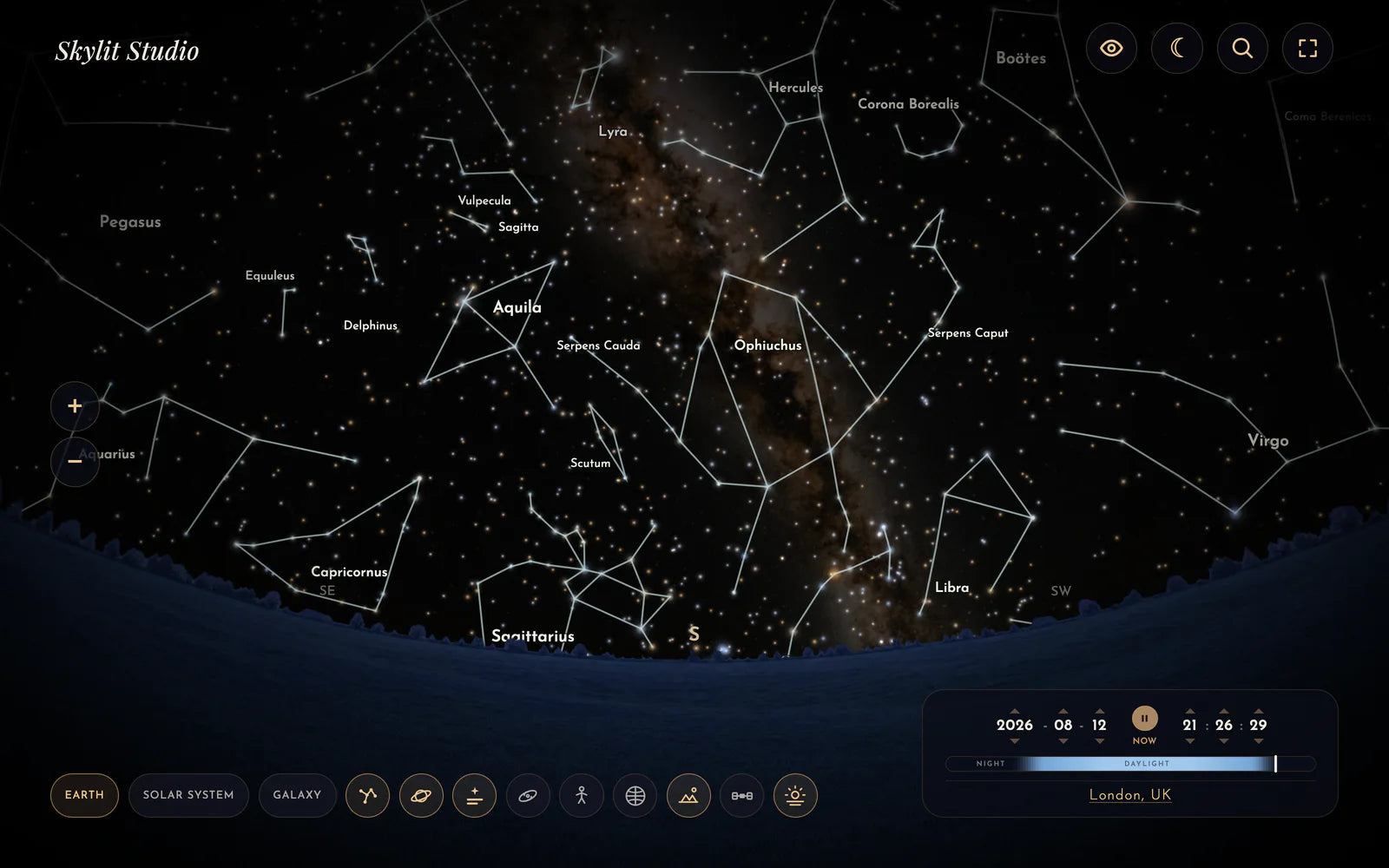
Our free Night Sky Explorer is a live planetarium in your browser. See the real stars, constellations, planets, Moon and Milky Way exactly as they were, travel through time, and when you find a moment worth keeping, turn it into a print.
Open the Night Sky Explorer →When Is the Next Planetary Alignment?
Groupings of three or four bright planets turn up most years, often more than once. Gatherings of five or six, counting the ones that need optics, come round every couple of years, as February and August 2026 both showed. A genuinely tight cluster, where several bright planets sit within a few degrees of one another, is much rarer and worth travelling for.
One word of caution about the alignment lists circulating elsewhere: a fair number are generated rather than calculated, and include line-ups that cannot physically occur. If a list places Venus in the pre-dawn eastern sky on 22 October 2026, it is simply wrong: Venus is between Earth and the Sun on 24 October and is not visible at all around that date, so sanity-check any claim before setting a 5am alarm. Our own approach is the opposite: positions get computed, never guessed, the same principle behind the astronomical precision behind our star maps.
Printing the Night the Planets Gathered
Here is the part that surprises people. Planetary positions are computable for any date at all, past or future. The same orbital mechanics that let us say where Saturn will be on 4 October let us reconstruct exactly how the sky looked over a particular town on a particular evening decades ago.

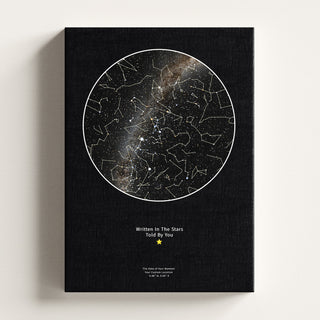
That is what a personalised star map from Skylit Studio does. You choose a date, a time and a place, and the sky is calculated as it genuinely appeared from that spot, stars in their true positions, drawn out as a print you can hang. If the night you want to keep is a night the planets gathered, whether that was February 2026 or an evening you still remember from childhood, it can be plotted and printed.
What makes it yours is the moment you picked and the words you put beneath it. The coordinates are just the starting point: the date, the place and the message are what turn them into something worth a wall.
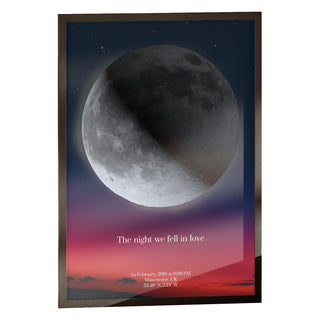
If the Moon is more your marker than the stars, our personalised moon phase prints do the same job for lunar phases, showing the Moon exactly as it appeared on a chosen date. And if you would rather start from the date and work outwards, our post on the night sky on a specific date and location explains how the lookup works.
Prints come in A4, 30 x 40 cm, 40 x 50 cm, 50 x 70 cm and 60 x 80 cm, unframed from £21.99, or framed in black, white or natural oak from £36.98.
Capture Your Moment in the Stars
Frequently Asked Questions
Is there still a planet parade in 2026 I can see?
Yes. Venus is at its best in the western evening sky around 15 August, Saturn reaches opposition on 4 October, and from November onwards Venus, Mars and Jupiter share the pre-dawn eastern sky, building through December.
Which direction should I look from the UK, and do I need a telescope?
West shortly after sunset for evening planets, east before sunrise for morning ones. Mercury, Venus, Mars, Jupiter and Saturn are all naked-eye objects when well placed; Uranus needs binoculars and Neptune needs a telescope, which is why headline counts of six or seven planets are usually a mix of what you can see and what you cannot. Planets never appear low in the northern sky from Britain.
How do I tell a planet from a star?
Watch whether it twinkles. Stars flicker because they arrive as a single point of light that the atmosphere jostles. Planets show a tiny disc, so their light stays steady. Check something well above the horizon, since everything twinkles when seen through thick low-level air.
Does a planetary alignment mean anything astrologically?
Astronomically it is a matter of viewing geometry rather than any physical event, and the planets exert no measurable extra influence on Earth when they appear grouped. Whatever meaning you take from the sight is your own, which is a fair reason to remember the night.
Can I get a print of the sky on the night of an alignment?
Yes. Because star positions are calculated rather than photographed, any date, time and location can be reconstructed and printed, including nights from many years ago. You pick the moment and the wording, and the sky is drawn as it appeared from that spot.
The best thing about a planet parade is how little it asks of you. Step outside, face the right way, let your eyes settle, and pick out the steady lights among the twinkling ones. Then, if the night turns out to be one you want to keep, it can be calculated exactly as it was and hung on a wall. Written In The Stars. Told By You.


