


The first day of autumn 2026 in the UK is 1 September (meteorological autumn) or Wednesday 23 September at 01:05 BST (the autumn equinox, astronomical autumn). Most people asking when autumn starts mean the equinox: the instant the Sun crosses the celestial equator heading south and the nights properly draw in.
All Four UK Season Start Dates, 2026
| Season | Meteorological start | Astronomical start (UK time) |
|---|---|---|
| Spring | 1 March 2026 | 20 March, 14:46 GMT (spring equinox) |
| Summer | 1 June 2026 | 21 June, 09:25 BST (summer solstice) |
| Autumn | 1 September 2026 | 23 September, 01:05 BST (autumn equinox) |
| Winter | 1 December 2026 | 21 December, 20:50 GMT (winter solstice) |
Both start dates for autumn are correct, they just answer different questions. The Met Office uses whole calendar months, on 1 September, so its seasonal statistics are comparable year on year. Astronomers use the Earth's tilt, so the first day of autumn on the sky's own calendar is the equinox, and below we set out both, plus why 2026 lands on 23 September when so many sources still print the 22nd.
It also marks something worth noticing overhead: proper darkness returns to the whole UK within days of the equinox, which is why we treat it as the informal start of Britain's stargazing season rather than just a date to note and forget.
When Does Autumn Start in the UK in 2026?
The September equinox in 2026 falls on Wednesday 23 September at 00:05 UTC, which is 01:05 BST on UK clocks, since British Summer Time is still running. That moment is the start of astronomical autumn across the northern hemisphere.
Autumn Equinox 2026: The UK Numbers
- Date and time: Wednesday 23 September 2026, 01:05 BST (00:05 UTC)
- Astronomical autumn begins: that same moment
- Meteorological autumn began: 1 September 2026
- London on the day: sunrise 06:48, sunset 18:57, about 12 hours 9 minutes of daylight
- Edinburgh on the day: sunrise 06:59, sunset 19:09, about 12 hours 10 minutes
- True equal day and night (equilux): 25 September across most of the UK
- Clocks go back: Sunday 25 October 2026, at 02:00 BST
Why 2026 is the 23rd and not the 22nd
Plenty of UK pages will tell you the autumn equinox is on 22 September, and for the last few years they have been right. It is worth understanding why that changes in 2026, because the difference is real rather than a typo.
A tropical year, one full circuit of the seasons, runs to roughly 365 days and 6 hours. Our calendar year is 365 days flat, so the equinox arrives about six hours later on the clock each year, then a leap day yanks it back by nearly a full day. In 2024 the September equinox fell on 22 September at 12:44 UTC. In 2025 it slipped to 22 September at 18:19 UTC. Add another six hours and 2026 tips over midnight: 00:05 UTC on 23 September. In 2027 it lands on the 23rd again, and 2028's leap day pulls the sequence back to the 22nd.
So the date genuinely moves. If a source is showing 22 September for 2026, it is either recycling last year's figure or quoting the local time somewhere in the Americas, where clocks had not yet reached midnight when the crossing happened. It is one instant, described by different calendars.
If you are mapping out the season, our 2026 astronomical events calendar sets the equinox alongside the year's meteor showers and eclipses, and the UK celestial events calendar gives the same year at a glance.
1 September or 23 September? Both Count as Autumn
The reason "when does autumn start" has two answers is that Britain runs two calendars side by side, and neither is wrong.
Meteorological autumn: 1 September to 30 November
The Met Office splits the year into four three-month blocks aligned to the calendar: spring is March to May, summer June to August, autumn September to November, winter December to February. Whole months make the statistics comparable, so when you read that it was the warmest autumn on record, that is the season being measured. On this definition the first day of autumn 2026 was Tuesday 1 September, and it does not move from year to year.
Astronomical autumn: 23 September to 21 December
The astronomical seasons are set by the Earth's tilt rather than the calendar, running from equinox to solstice. Autumn opens at the September equinox and closes at the December solstice, which in 2026 falls on 21 December. Because the equinox drifts by about six hours a year, this start date shifts between 22 and 23 September. On this definition autumn 2026 begins at 01:05 BST on Wednesday 23 September.
In practice, the weather forecast and the school term follow the first, and the sky follows the second. If you are marking the turn of the year for the view overhead, the equinox is the date that means something.
What Is the Autumn Equinox?
The Earth is tilted by about 23.4 degrees relative to its orbit, and that tilt stays pointed the same way all year. As we travel round the Sun, the northern hemisphere leans towards it for half the orbit and away for the other half. That single fact produces every season we have.
From the ground it shows up as the Sun tracing a different path each day, climbing higher through spring and sinking lower through autumn. Astronomers measure that path against a projection of Earth's own equator onto the sky, called the celestial equator, and across a year the Sun's track crosses that line exactly twice.
An equinox is one of those crossings. In September the Sun heads southward, passing from the northern half of the sky into the southern half and standing directly overhead at the equator as it goes. So the definition worth remembering is not about daylight hours at all. It is a geometric event, and the daylight consequences follow imperfectly.
An equinox is not a day. It is a moment, and every clock on Earth reads something different when it happens.
Skylit StudioWhy Day and Night Are Not Equal on the Equinox
The word equinox comes from the Latin for equal night. Look at the figures above and you will spot the problem: London gets a little over twelve hours and nine minutes of daylight on 23 September, which is nine minutes more than it should be. Two things are responsible, and both push the same way.
Sunrise is measured from the edge, not the middle
The geometry only balances if you track the exact centre of the Sun's disc, and official timings do not. Sunrise is logged the instant the upper edge appears above the horizon, and sunset the instant that same edge disappears. The Sun is about half a degree wide, so we count from first sliver to last.
The atmosphere bends the light
The larger effect is atmospheric refraction. Sunlight entering the atmosphere at a shallow angle is bent downward, lifting the Sun's apparent position by roughly half a degree near the horizon. At sunrise and sunset, the disc you are watching is really an image of a Sun already below the line.
Together they pad every day with several minutes of borrowed daylight, so the genuine balance point arrives a few days later, once the days have shortened enough to absorb it. That point has its own name: the equilux. In 2026 it falls around 25 September across most of the UK.
Equinox vs Solstice: What Is the Difference?
A solstice is an extreme: the moment the Sun reaches its furthest point north or south of the celestial equator, giving the longest and shortest days. The name means Sun standing still, because its noon height barely changes for several days around it. The December solstice in 2026 falls on 21 December.
An equinox is the crossing point midway between those extremes, and day length changes quickest here. Britain loses roughly four minutes of daylight every twenty-four hours through late September, which is why autumn seems to arrive so abruptly. A solstice is the peak of the curve. An equinox is the steepest part of the slope.
Make it personal
 Personalised Star Map | Custom Night Sky Print
From £21.99
View product →
Personalised Star Map | Custom Night Sky Print
From £21.99
View product →
 Personalised Moon Map | by Skylit Studio
From £21.99
View product →
Personalised Moon Map | by Skylit Studio
From £21.99
View product →
 Personalised Moon Phase Map for Family | by Skylit Studio
From £21.99
View product →
Personalised Moon Phase Map for Family | by Skylit Studio
From £21.99
View product →
 Custom Location Map | Personalised Map Print by Skylit Studio
From £21.99
View product →
Custom Location Map | Personalised Map Print by Skylit Studio
From £21.99
View product →
 Your Name From Orbit
From £21.99
View product →
Your Name From Orbit
From £21.99
View product →
 Print Your Universe - Custom Image Print
From £19.79
View product →
Print Your Universe - Custom Image Print
From £19.79
View product →
What Changes in the UK Night Sky After the Equinox
Proper darkness returns
For anyone who watches the sky from Britain, the equinox is the real start of the observing year. Around midsummer no part of the UK reaches astronomical darkness at all: even at the southern tip of Cornwall the Sun climbs back to within about 16.6 degrees of the horizon at its lowest, short of the 18 degrees the definition requires, and across Scotland the twilight glow lingers for weeks either side. By late September that is finished everywhere, and full darkness arrives at a sociable hour.
The autumn constellations take over
The Summer Triangle of Vega, Deneb and Altair still rides high at dusk, but it is sliding west. Rising to replace it is the Great Square of Pegasus, an enormous and slightly empty box of four stars that dominates the southern sky through autumn. From one corner of that square the chain of Andromeda stretches away, carrying the Andromeda Galaxy, the most distant thing most people in Britain will ever see without equipment. Look north-east and Cassiopeia's W is climbing towards its best, with Perseus behind it and the Pleiades low in the east later on.
Our guide to the constellations in the UK sky walks through finding them season by season, our interactive night sky explorer lets you spin the whole sky round and pick the constellations out for yourself, and we cover what the IAU constellations actually are separately.
Longer evenings, easier viewing
From late September a genuinely dark sky is available by around nine in London, and closer to a quarter past in Scotland, which puts stargazing back within reach of anyone with work in the morning. Start with our piece on the night sky tonight with no equipment, and our round-up of stargazing spots across the UK covers the darker sites worth the drive.
The Run-Up to the Clock Change
The equinox starts a countdown of just over four weeks to the other date that reshapes British evenings. British Summer Time ends on Sunday 25 October 2026, when clocks go back one hour at 02:00 BST and the country returns to GMT.
Nothing astronomical happens that night. The Sun does not move and total daylight is unchanged. What changes is where we have chosen to put the hour. In London, sunset falls at 17:49 on Saturday 24 October and at 16:47 on Sunday 25 October, so an hour of evening light disappears in one step and darkness arrives before most people have finished the commute.
How to Mark the Date
An equinox is easy to let pass, which is exactly why it rewards being marked deliberately. Start with the simplest observation there is: on the equinox the Sun rises almost due east and sets almost due west, from everywhere on Earth. Note where it comes up against a landmark from your window, then look again at midwinter.
The sky above your own town, date-stamped
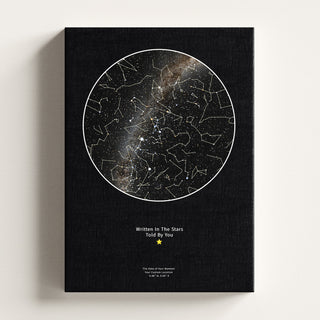
A personalised star map is the natural way to keep the date itself. You give us a place, a date and a time, and we calculate the real positions of the stars as they stood over that spot at that instant. Set it to 23 September 2026 over your own town and you have the equinox sky as it actually stood: the Summer Triangle overhead, Pegasus rising.

What makes it personal is the pairing of the moment you choose with the words printed beneath it. Our page on how it works covers the process, and if you are torn between dates we have written about choosing the right date for a star map and about the night sky on a specific date and location.
The place you watched it from
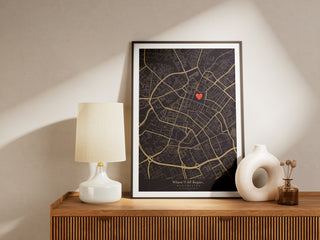
If the memory is more about where you stood than what was overhead, a personalised location map fits better. The customiser has a free zoom, so you set the scale yourself: a stretch of coastline, the town you drove out from, or a tight view of the single hill you climbed for the sunrise. You can optionally drop a pin on the exact spot, though plenty of people leave it unmarked. Our walkthrough on personalising a location map with zoom, area and pin shows how those choices play out.
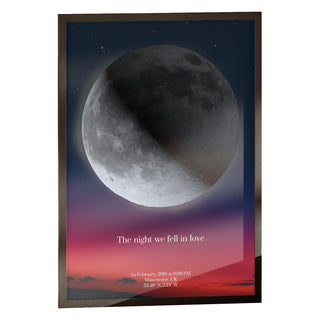
The two pair naturally: the sky above and the ground below, from the same morning. If the moon is what you remember instead, our personalised moon phase prints take the same date the same way.
Sizes and Prices
Every print at Skylit Studio comes in five sizes: A4, 30x40 cm, 40x50 cm, 50x70 cm and 60x80 cm. Unframed prints start at £21.99 and run to £69.99 for the largest. Framed versions, in black, white or natural wood finishes, run from £36.98 to £119.98, with dark brown available in A4 and 30x40cm. Gallery-wrapped canvas comes in four sizes, A4 up to 50x70 cm, starting at £49.99.
Order by 3PM on a working day and your print is dispatched the same day from our studio in Manchester, with free tracked UK delivery. Unframed A4 ships flat in a rigid cardboard mailer, while larger unframed sizes are rolled into a sturdy tube. Framed prints are wrapped and boxed, and canvases arrive ready to hang.
Frequently Asked Questions
When does autumn start in the UK in 2026?
Astronomical autumn starts at 01:05 BST on Wednesday 23 September 2026, the moment of the autumn equinox. Meteorological autumn, the version the Met Office uses for weather statistics, started earlier, on 1 September 2026. Both definitions are in everyday use, so the first day of autumn is 1 September or 23 September depending on which one you mean.
When is the first day of autumn 2026?
23 September 2026 if you are going by the equinox and the Earth's tilt, and 1 September 2026 if you are going by the meteorological calendar of whole months. The equinox version is the one that matches the sky: it is when the Sun crosses the celestial equator and the northern hemisphere's nights become longer than its days.
Why do some sources say the equinox is 22 September 2026?
The equinox is a single instant, and it happens at 00:05 UTC on 23 September 2026. In North and South America local clocks had not yet reached midnight, so it is still 22 September there. Some UK pages also simply carry over the 2025 date, which genuinely was 22 September. The equinox drifts about six hours later each year until a leap day pulls it back, which is why 2026 is the year it tips past midnight into the 23rd.
Why is day not exactly equal to night on the equinox?
Two reasons, both adding daylight. Sunrise and sunset are timed from the upper edge of the Sun's disc rather than its centre, and atmospheric refraction makes the Sun appear above the horizon slightly before it truly rises and after it truly sets. The genuine twelve-hour day, the equilux, arrives on 25 September 2026 across most of the UK.
What can I see in the UK sky after the September equinox?
Astronomical darkness returns to the whole country. Around midsummer no part of the UK reaches it at all, and in Scotland it stays away for longer still, so late September is when proper night comes back, early enough in the evening to be practical. The Great Square of Pegasus, the Andromeda chain and Cassiopeia climb into the eastern half of the sky.
When do the clocks go back in 2026?
Sunday 25 October 2026. Clocks go back one hour at 02:00 BST and the UK returns to GMT until spring. Sunset shifts roughly an hour earlier overnight, though total daylight is unaffected.
Can I have a print made of the sky on the equinox?
Yes. A star map from Skylit Studio is calculated from the date, time and place you enter, so you can set it to 23 September 2026 over any location and get the real star positions for that moment, with your own wording beneath.
The Turning Point
Autumn 2026 arrives twice in the UK: once on the calendar on 1 September, and once in the sky at 01:05 BST on 23 September. The second is the one you can watch happen. On the other side of it the nights lengthen, the constellations change over, and Britain's stargazing season properly begins. If you would like to keep it, a star map of your own town on 23 September 2026 records where the sky stood at the moment the year turned. Written in the stars, told by you.


