


One personalised print is a gift. Three or four of them, arranged well, become the thing people notice the moment they walk into the room. That is the appeal of a gallery wall: instead of a single frame floating on a large blank wall, you get a small collection that tells a run of stories, the night someone was born, the moon over a wedding, the street where a family started.
The catch is that gallery walls go wrong easily. Frames end up too far apart, sizes fight each other, or the whole cluster sits so high it looks like it is escaping up the wall. This guide covers the layouts that reliably work, the rules of thumb for mixing sizes and frame colours, and how to preview the arrangement before you commit to buying anything.
Start With the Wall, Not the Prints
Almost every gallery wall problem traces back to the same mistake: buying the prints first, then trying to find a wall that suits them. Reverse it. Measure the space you actually have, then choose sizes to fill it properly.
A useful starting figure is that your arrangement should occupy roughly two thirds to three quarters of the usable wall width. Above a sofa, that means the cluster spans about two thirds of the sofa's width. Above a sideboard or a bed, the same logic applies. A cluster narrower than half the furniture below it will always look undersized, no matter how lovely the individual pieces are.
Measure These Three Things First
- Usable wall width: from edge to edge, minus anything you must avoid such as light switches or a radiator
- Width of the furniture below: your arrangement wants to be about two thirds of it
- Clearance above the furniture: leave 15 to 25 cm between the top of a sofa back and the bottom frame
Write those numbers down. Every decision that follows, size, count, spacing, is easier once you know how much room you are actually filling.

Four Gallery Wall Layout Ideas That Work
There are endless ways to arrange frames, but four patterns cover most real rooms. Pick the one that matches your wall shape and how many prints you want.
1. The clean grid
Two by two, three by two, or a single row of three, all the same size, all the same frame, evenly spaced. This is the most forgiving layout in existence and the one to choose if you are nervous. Because every frame matches, the eye reads the group as one object and the personalisation inside does all the talking.
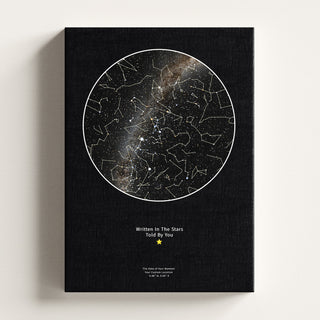
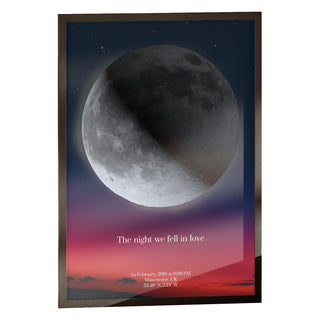
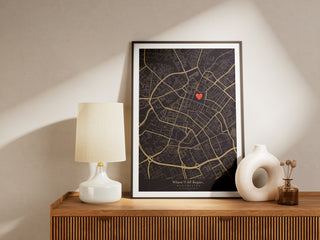
A grid suits prints that share an orientation. A personalised star map, a custom moon phase print and a personalised location map are all portrait, so three of them at 30 x 40 cm in matching frames make an effortless row. The shared format does the visual work; the different subjects keep it interesting.
2. The anchor and satellites
One large print carries the wall, and two or three smaller ones sit around it. This is the layout for people who want a focal piece rather than a democratic grid. Choose a 50 x 70 cm anchor and surround it with A4 or 30 x 40 cm companions, keeping the gaps between everything identical.
The trick is that the anchor should be clearly bigger, not slightly bigger. A 50 x 70 cm next to a 40 x 50 cm reads as an accident. A 50 x 70 cm next to two A4s reads as a decision.
3. The horizontal run at eye level
Three to five prints in a single line, all hung so their centres share one horizontal axis. Perfect for hallways, stairwell landings and long walls above a console table. Because there is only one axis to get right, this layout is very tolerant of mixed sizes, as long as the centres line up.
This is where the family moon phase print earns its place. It is the one landscape piece in the range, so it can sit at one end of a run and stop the line feeling like a procession of identical rectangles. It can hold one moon per family member's birthday, or trace a single person's timeline across up to four moments: a birth, a first day at university, a graduation, a wedding day. Either way, its width gives the row somewhere to rest.
4. The organic cluster
Frames of mixed sizes arranged around an invisible centre, with consistent gaps but no shared grid lines. This is the hardest layout to pull off and the most rewarding when it lands, because it looks collected rather than bought.
The rule that saves organic clusters is that the outer edge should still resolve into a rough rectangle or oval. Individual frames can sit anywhere inside that shape, but if the silhouette wanders, the wall looks unfinished. Build outwards from the biggest piece and keep every gap the same measurement.
Make it personal
 Personalised Star Map | Custom Night Sky Print
From £21.99
View product →
Personalised Star Map | Custom Night Sky Print
From £21.99
View product →
 Personalised Moon Map | by Skylit Studio
From £21.99
View product →
Personalised Moon Map | by Skylit Studio
From £21.99
View product →
 Personalised Moon Phase Map for Family | by Skylit Studio
From £21.99
View product →
Personalised Moon Phase Map for Family | by Skylit Studio
From £21.99
View product →
 Custom Location Map | Personalised Map Print by Skylit Studio
From £21.99
View product →
Custom Location Map | Personalised Map Print by Skylit Studio
From £21.99
View product →
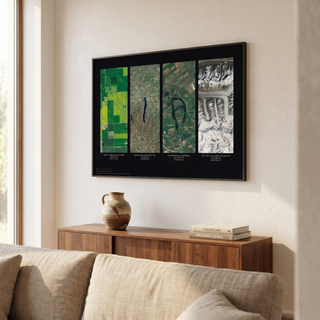
 Your Name From Orbit
From £21.99
View product →
Your Name From Orbit
From £21.99
View product →
 Print Your Universe - Custom Image Print
From £19.79
View product →
Print Your Universe - Custom Image Print
From £19.79
View product →
How to Mix Frame Sizes on a Wall
Mixing sizes is where most multi print wall display ideas fall apart, and the fixes are simpler than people expect.
Skip a size. Sizes that sit next to each other in the range look like a mistake when hung together. Jump one: pair A4 with 40 x 50 cm, or 30 x 40 cm with 50 x 70 cm. The contrast then reads as intentional hierarchy.
Limit yourself to two or three sizes. Four or more different dimensions in one cluster is usually one variable too many. Two sizes plus a single larger anchor is plenty of variety for a wall of five.
Balance the weight. If your largest print sits on the left, put your second heaviest cluster of small frames on the right so the arrangement does not lean. Weight here means visual area, not literal kilograms.
Mix orientation deliberately, not accidentally. Portrait prints stack and grid beautifully. One landscape piece among them adds rhythm. Two landscape pieces placed at random tend to pull the arrangement apart. If you are including both the family moon print and Your Name From Orbit, which is also landscape, give them opposite ends of the wall rather than neighbouring slots.
One note on the family moon print: because it is landscape, its sizes are written width first, so 40 x 30 cm, 50 x 40 cm, 70 x 50 cm and 80 x 60 cm. It is the same physical footprint as the portrait sizes, turned on its side. Worth remembering when you are sketching a layout on paper.
Choosing and Mixing Frame Colours
Skylit Studio frames come in black, white, natural and dark brown. Dark brown is available in A4, 30 x 40 cm and 40 x 50 cm, which makes it a natural choice for the smaller companions in a cluster rather than the anchor.

The safest approach for a gallery wall is a single frame colour throughout. It lets the artwork differ wildly while the arrangement still reads as one coherent piece, and it is almost impossible to get wrong.
If you do want to mix, mix two colours and repeat them, never three colours used once each. Two blacks and two naturals alternating looks deliberate. One black, one white and one natural looks like whatever was in the cupboard. Pick up a colour already in the room, the wood of a sideboard, a dark window frame, so the frames feel connected to the space rather than dropped into it.
For a fuller walkthrough of matching frame finishes to a room's palette, our guide to styling your home with celestial artwork covers lighting, wall colour and placement in more depth.
A gallery wall is not a collection of prints. It is one piece of art that happens to arrive in several boxes.
Skylit StudioPreview the Whole Wall Before You Buy
Sketching a layout on paper helps, but it will not tell you whether a 50 x 70 cm anchor overwhelms your alcove or whether four A4 frames look lost above a double bed. That is what our gallery wall builder is for.
It lets you place several prints together and see how the sizes and the gaps between them look as a group, before anything is ordered. You can change the sizes and the frame finishes and watch the balance shift, which is far more informative than picturing it. Most people discover one of two things: that they need a bigger anchor than they assumed, or that they wanted four pieces rather than three.

If you would rather not fill it slot by slot, start with Describe your wall at the top of the builder. Tell it who the wall is for and the dates and places that matter, for example where you met, your wedding day and the day your first child was born, and it designs every print at once and lays the whole set out in the preview so you can judge them together. Then open any single print with Edit design to fine-tune it in its own customiser, the wording, the style, the zoom, and it drops back into the same slot in the preview.
It also removes the most expensive mistake in this whole exercise, which is ordering a print, hanging it, deciding it is too small, and starting again. Test the arrangement first, then order the sizes that the preview tells you to order.
If you are still deciding what each print should show, two guides will help: how to choose the date for your star map, and our walkthrough of personalising a location map with zoom, area and pin. The location map customiser has a free zoom slider, so you decide whether the print shows a whole city or a few streets, and you can optionally drop a marker on an exact spot.
Spacing, Heights and Hanging
Once the layout is settled, the numbers below turn it into something you can actually put on a wall.
Gallery Wall Measurements Worth Memorising
- Gap between frames: 5 to 8 cm. Use the same gap everywhere, including diagonally in a grid
- Centre height: the centre of the whole arrangement should sit around 145 to 150 cm from the floor, which is average eye level
- Above furniture: 15 to 25 cm between the top of the furniture and the bottom of the lowest frame
- Seated rooms: in a room where people are mostly sitting, drop the centre by about 10 cm
Before you drill anything, cut paper templates to the size of each frame and tape them to the wall. Live with them for a day. It costs nothing and it catches problems that no amount of planning does, such as a cluster that competes with a light fitting or drifts too close to a doorframe.
Hang the anchor piece first and work outwards from it. If you start at an edge, small errors accumulate and the final frame ends up somewhere it should not be.
Sizes, Finishes and What Arrives
Prints come in A4, 30 x 40 cm, 40 x 50 cm, 50 x 70 cm and 60 x 80 cm, with the family moon print using the same footprints in landscape. Unframed prints start at £21.99 for A4 and run to £69.99 at 60 x 80 cm. Framed prints are £36.98 for A4 up to £119.98 for 60 x 80 cm. Canvas prints run from £49.99 for A4 to £99.99 at 50 x 70 cm, which is the largest canvas size we make.

Canvas is worth a thought for gallery walls specifically. It arrives boxed and ready to hang with no frame needed, so a canvas piece sitting among framed prints adds a change of texture without adding another frame colour to manage.
How things arrive matters when you are ordering several at once. Unframed A4 ships flat in a rigid cardboard mailer. Unframed prints at 30 x 40 cm and above are rolled and sent in a sturdy tube, so allow them a little time to settle flat before framing. Framed prints are wrapped in protective materials and boxed. If you want the full production story, our how it works page walks through it.
Orders placed by 3PM Monday to Friday are dispatched the same working day, and UK delivery is free via Royal Mail Tracked 48, which takes 2 to 4 working days after dispatch. Canvas may need one extra working day before dispatch because of the stretching and finishing. If you are ordering a wall's worth in one go, everything ships together once all items are ready.
Written In The Stars. Told By You: the personal part of a gallery wall is never the astronomy, it is which moments you chose to put up there and what you wrote underneath them.
Frequently Asked Questions
How many prints do I need for a gallery wall?
Three is the practical minimum for something that reads as a gallery wall rather than a pair. Five to seven suits a large living room wall. Odd numbers tend to arrange more naturally in clusters, while even numbers are better for grids.
Can I mix star maps, moon maps and location maps on the same wall?
Yes, and they are designed to sit together. Star maps, moon maps and location maps are all portrait format, so they grid and stack cleanly. The family moon print is landscape, which makes it a useful anchor or end piece in a mixed run.
How much space should I leave between frames?
Between 5 and 8 cm, kept identical throughout the arrangement. Consistency matters more than the exact figure. Larger frames can take the upper end of that range, smaller ones the lower end, but do not vary the gap within a single cluster.
Should all the frames be the same colour?
A single colour is the easiest way to make a mixed set of artwork look coherent, and it is what we would suggest for a first gallery wall. If you want to mix, use two colours and repeat each of them at least twice so the mix looks deliberate.
Can I see the layout before ordering?
Yes. The gallery wall builder lets you put several prints together and preview how the sizes, finishes and gaps look as a group before you buy anything, which is the quickest way to find out whether your anchor piece is big enough.
Do I have to buy all the prints at once?
Not at all. Plenty of people start with two or three and add a piece each year as new moments arrive. If you plan to build over time, decide the frame colour and the grid spacing at the start so later additions slot in without rethinking the whole wall.
What size works above a standard three seater sofa?
A three seater is typically around 200 cm wide, so aim for an arrangement spanning roughly 130 to 150 cm. Three 40 x 50 cm prints with 6 cm gaps, or a 50 x 70 cm anchor with four A4 companions, both fill that span comfortably.
A gallery wall built from personalised prints has one advantage over anything bought off a shelf: every piece on it means something to the people who live there. Plan the wall, preview the sizes, then choose the moments.


