


Just after the winter solstice, while most of the country is wrapping presents and counting down to Christmas, one more meteor shower arrives. The Ursids are the last notable meteor shower of the year, and their meteors appear to stream from the Little Bear, the small constellation that holds the North Star.
The Ursid meteor shower 2026 UK peak falls on the evening of Tuesday 22 December. It is a modest shower, and this year a bright Moon will be in the sky all night. Even so, the radiant never sets from Britain, the nights are the longest of the year, and a patient watcher can still catch a few shooting stars. Here is when to look and where to face.
Ursid Meteor Shower 2026: Quick Facts
The Ursids at a glance
- Active: 17 to 26 December 2026
- Peak: 22 December, around 10pm GMT (International Meteor Organization prediction)
- Best night to watch: Tuesday 22 into Wednesday 23 December, with the night before also worth a look
- Radiant: close to the star Kochab in Ursa Minor, the Little Bear
- Typical rate (ZHR): about 10 meteors an hour under perfect conditions
- Moon: waxing gibbous, more than 90 per cent lit and up all night, two days before full
- Parent comet: 8P/Tuttle
When to Watch the Ursids in 2026
The Ursids are active for about ten days, from 17 to 26 December, but almost all of their activity is packed into a short window around the peak. For 2026 the International Meteor Organization places the maximum on 22 December at about 22:00 GMT. That timing is good news for UK observers, because it falls in full darkness, with the radiant already above the northern horizon.
So the night to circle is Tuesday 22 December. Head out any time after the sky is properly dark (around 6pm) and keep watching through to the early hours of Wednesday 23 December. The hours either side of 10pm are your best bet. The night of 21 to 22 December is a sensible back-up if the forecast for the 22nd looks cloudy, although rates will be lower.
The Moon in 2026: The Honest Picture
This is the year's main drawback for the Ursids. Full Moon falls in the early hours of 24 December, so on peak night the Moon is a bright waxing gibbous, more than 90 per cent lit. It rises in the early afternoon and does not set until after sunrise on the 23rd, so there is no moon-free window at all.
Moonlight washes out fainter meteors, a real cost for a modest shower. Two things help, though. First, the Moon sits in Taurus, high in the southern sky, while the Ursid radiant is in the north. Second, Ursid meteors are relatively slow, entering the atmosphere at about 33 kilometres per second, so the brighter ones linger long enough to catch. Sit facing north with the Moon behind you, ideally with a building or a hedge blocking its glare, and you will still see the brightest meteors.
If you only have the energy for one meteor shower this December, the Geminid meteor shower in 2026 peaks on 14 December under a thin crescent Moon and is far more prolific. The Ursids are the encore.
Where to Look: Finding the Ursid Radiant
Every meteor shower appears to radiate from one point in the sky, called the radiant. For the Ursids, that point lies close to Kochab, the second brightest star in Ursa Minor. Kochab and its neighbour Pherkad form the two "guardians" at the end of the bowl of the Little Dipper, the small pattern whose handle ends at Polaris.
Finding Kochab in three steps
- Find the Plough. On a December evening the Plough (part of Ursa Major) sits low in the north, climbing into the north-east as the night goes on.
- Use the pointers to find Polaris. The two stars at the end of the Plough's bowl point up to Polaris, the North Star, which marks the end of the Little Dipper's handle.
- Look for the orange star. From Polaris, follow the faint handle of the Little Dipper to its bowl. The brightest star there, with a slightly orange tint, is Kochab.
Because Ursa Minor is so close to the celestial pole, the Ursid radiant never sets anywhere in the UK. From Manchester, it is at its lowest, still around 38 degrees up in the north, in the late evening around peak time, and it climbs steadily higher towards dawn. So you can watch all night.
You do not need to stare at the radiant itself. Meteors appear anywhere in the sky, and look longer a little way from it. Look about a third of the way up, across a wide patch of sky in the north, and trace any meteor you see backwards. If it points back towards the Little Dipper, it is an Ursid. To practise beforehand, our interactive night sky explorer shows exactly where Ursa Minor sits on any date and from any UK town.
How Many Meteors Can You Expect?
The Ursids have a zenithal hourly rate, or ZHR, of about 10. That is the number a single observer would see in an hour under a perfectly dark sky with the radiant overhead. With a bright Moon in 2026, a realistic count from a dark site is a handful an hour, and fewer from a town.
That may sound low beside the summer Perseid meteor shower, but the Ursids have a history of the occasional outburst. Notable surges were recorded in 1945 and 1986, when rates briefly climbed far above normal, and smaller bursts have been seen in more recent years. No major outburst is predicted for 2026, but part of the appeal is that you never quite know.
Make it personal
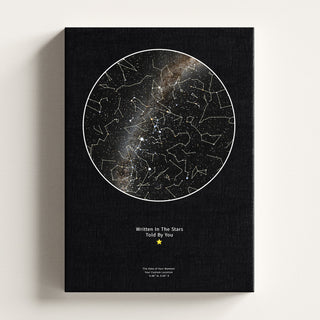
 Personalised Star Map | Custom Night Sky Print
From £21.99
View product →
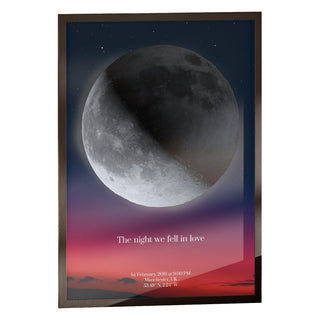
 Personalised Moon Map | by Skylit Studio
From £21.99
View product →
 Personalised Moon Phase Map for Family | by Skylit Studio
From £21.99
View product →
 Custom Location Map | Personalised Map Print by Skylit Studio
From £21.99
View product →
 Your Name From Orbit
From £21.99
View product →
 Print Your Universe - Custom Image Print
From £19.79
View product →
How to Watch, Step by Step
Watching the Ursids needs no telescope or binoculars. Your eyes take in far more sky than any magnified view.

- Check the forecast. December cloud is the real enemy. If the 22nd looks overcast, try the 21st or the 23rd.
- Dress for a long, cold wait. Late December nights can drop below freezing. Wear layers, a hat and gloves, and bring a flask of something hot.
- Get comfortable. A reclining garden chair or a camping mat and sleeping bag lets you look up for long periods without neck ache.
- Face north and put the Moon behind you. Shade it with a wall, a tree or the side of the house.
- Let your eyes adapt. Allow at least 20 minutes away from bright lights. Use a red torch, and keep your phone screen dimmed or put away.
- Give it time. Meteors come in bursts with lulls between. Plan on at least an hour.
Face north, put the Moon behind you, and give the sky an hour. The Ursids reward patience more than luck.
Where in the UK to Watch
Any spot with an open view of the northern sky and as little artificial light as possible will do. A back garden with the house blocking the Moon works well. For the best views, the UK's dark sky areas are hard to beat: Galloway Forest Park, Northumberland, Exmoor, the Brecon Beacons (Bannau Brycheiniog) and Eryri (Snowdonia) all offer genuinely dark skies.

Where the Ursids Come From
Every meteor is a speck of dust burning up in the upper atmosphere. The Ursid particles were shed by comet 8P/Tuttle, which loops around the Sun roughly every 13.6 years. Each December, Earth passes through the stream of debris it has left behind.
The shower is often credited to the English astronomer William F. Denning, who recorded it in the early twentieth century. It is still underobserved today, largely because it falls in the busiest week of the year.
The Last Shower of the Year, Under the Longest Nights
The Ursids arrive the day after the winter solstice in 2026, which falls at 8:50pm GMT on Monday 21 December. On peak night, the Sun sets in Manchester before 4pm and does not rise again until after 8am, so there are more than sixteen hours between sunset and sunrise and around twelve hours of full darkness.
The first big shower of the new year is only days behind: the Quadrantid meteor shower in 2027 peaks in early January, and its radiant lies in the same northern part of the sky. For a broader look at what else is on show on any given evening, our guide to the night sky tonight in the UK is a good starting point, and our Leonid meteor shower guide covers November's shower.
Keeping the Night
A shower like the Ursids is rarely about the numbers. It is about who is out there with you: a parent and child wrapped in blankets on the lawn, or a couple on a winter break in the hills. The stars above you that night are worth remembering.
A personalised star map from Skylit Studio captures the sky for the exact date, time and place you choose, so you can keep the night you watched the year's last meteor shower together. You can read about the astronomical precision behind our star maps if you are curious. What makes the print personal is the pairing of that moment with your own words in the message beneath the chart. Written In The Stars. Told By You.

Star maps start from £21.99 for an unframed print, with framed and canvas options across sizes from A4 to 60 x 80 cm. Orders placed by 3pm on a working day are dispatched the same day, with free tracked UK delivery. If you would like one in time for Christmas, the free-delivery cut-off for UK mainland is 3pm on Thursday 17 December (canvas by 3pm on Tuesday 15 December). Our how it works page runs through the steps from choosing your moment to delivery, and how the real night sky becomes a print explains the rest.
Capture Your Moment in the Stars
Frequently Asked Questions
When is the Ursid meteor shower 2026 in the UK?
The Ursids are active from 17 to 26 December 2026. The peak is predicted for 22 December at around 10pm GMT, so the best night to watch from the UK is Tuesday 22 into Wednesday 23 December.
What time is best to watch the Ursids?
In 2026, the evening and late evening of 22 December, around the predicted peak at 10pm GMT. The radiant is above the horizon all night from the UK, so you can watch from full darkness at around 6pm right through to the early hours.
Which direction should I face?
Face north. The radiant lies near the star Kochab in the Little Dipper, not far from Polaris. In 2026 facing north also keeps the bright Moon, which is in the southern sky, behind you.
Will the Moon affect the Ursids in 2026?
Yes. Full Moon is on 24 December, so on peak night the Moon is more than 90 per cent lit and up all night. Fainter meteors will be lost, but brighter Ursids will still be visible if you shield the Moon from your view.
Is the Ursid meteor shower the last meteor shower of the year?
It is the last notable meteor shower of the calendar year. The next major shower is the Quadrantids, which peak in early January.
Do I need a telescope or binoculars?
No. Meteors are best seen with the naked eye, which takes in a wide area of sky. Binoculars and telescopes narrow your view and make you more likely to miss them.
On the evening of 22 December, wrap up, step outside, find the Plough and follow it to Polaris and the Little Dipper. Put the Moon behind you, settle in and give the northern sky an hour. Whatever you see, it is one last reason to be out under the stars before the year turns.


