



Every spring there is one Saturday night that is an hour shorter than all the others, and one Sunday evening when the light suddenly hangs around for longer than anyone expects. If you are here to check the date, here it is straight away: in the UK, the clocks go forward in 2027 on Sunday 28 March.
That answers the lookup. The rest of this guide covers the rule behind the date, what the change does to the evening sky, and why the weeks just before it are the last comfortable chance this season to step outside after dinner and see a properly dark sky.
When Do the Clocks Go Forward in 2027 in the UK?
The clocks go forward on Sunday 28 March 2027. At 1am Greenwich Mean Time, clocks spring forward one hour to 2am, and British Summer Time begins. You lose an hour in bed that night, and from Sunday evening onwards sunset reads an hour later by the clock.
The 2027 Clock Change at a Glance
- Date: Sunday 28 March 2027
- Time: 1am GMT becomes 2am BST
- Direction: forward one hour, so one hour less sleep
- What begins: British Summer Time (BST)
- What ends: Greenwich Mean Time (GMT) for the summer
- Next change: back again on Sunday 31 October 2027
Phones, laptops and most connected devices update themselves overnight. The usual stragglers are the oven, the microwave, the car clock, the central heating timer and any wall clock or wristwatch, so a quick lap of the house on Sunday morning saves a few confused moments later in the week.
The UK Rule: Why It Is Always the Last Sunday in March
The UK clock change is set by weekday rather than by date. British Summer Time starts on the last Sunday in March and ends on the last Sunday in October. In 2027, 31 March falls on a Wednesday, which makes Sunday 28 March the last Sunday of the month, and therefore the day the clocks go forward.
The changeover happens at 1am GMT, a quiet hour chosen so it disrupts as little as possible. The clocks jump straight from 00:59 to 02:00, so on the night of Saturday 27 March, the hour between 1am and 2am simply does not appear on British clocks.
How it fits the wider calendar
BST began in 2026 on Sunday 29 March and ended on Sunday 25 October, which we covered in our guide to when the clocks go back in 2026. The 2027 cycle then runs from 28 March to 31 October. GMT, the time the UK keeps through winter, is also the reference point the world's time zones are counted from, named after the meridian at the Royal Observatory Greenwich.
The sky does not change on 28 March. The clock simply moves the darkness later into the evening.
Skylit StudioWhat Actually Changes in the Evening Sky
Nothing happens to the stars when the clocks go forward. The evenings were already drawing out through February and March, because the northern hemisphere is tilting back towards the Sun, a shift that passes the spring equinox on 20 March 2027. That change is gradual. The clock change is not.

In London, the sun sets at around 6.25pm GMT on Saturday 27 March. On Sunday 28 March the same sunset reads as roughly 7.25pm BST. Further north the evenings are a little longer still: in Manchester and Edinburgh, sunset that Sunday is closer to 7.35pm and 7.40pm by the clock.
Full darkness moves later too. On the evening of the change, the last trace of twilight leaves the London sky at roughly 9.20pm BST, and later in the north. By the end of April, that point has slipped to nearly 11pm in London and past midnight in Edinburgh. Around midsummer, much of the UK never reaches full astronomical darkness at all. Our guide to when it gets dark in the UK explains the three stages of twilight in more detail.
The Last Stretch of Dark Evenings Before Summer
This is where daylight saving time in the UK matters for anyone who likes the night sky. From late October to late March, the stars are out during ordinary evening hours: after work, after the school run, before bedtime. From 28 March, that window shrinks quickly, and by May most casual stargazing in Britain means staying up late.
Why March evenings are worth catching
Early to mid March offers a sweet spot. The worst of winter's cold has usually passed, the evenings are dark by around 7pm, and the bright winter constellations are still visible in the west after sunset, while the spring stars rise in the east. It is the one time of year when you can see both seasons' skies in a single comfortable evening.
Make the most of the remaining weeks
If you have been meaning to get out to a darker spot, the weeks before the clocks go forward in 2027 are the time to do it. Our round-up of stargazing spots in the UK is a good starting point, and you can check what will be overhead from your own postcode with our interactive night sky explorer before you set off.
What to Look For Before the Clocks Go Forward
None of these needs a telescope. Give your eyes twenty minutes away from screens and outdoor lights, and the sky fills in noticeably.
A Late Winter and Early Spring Checklist
- Orion. Low in the south west after dark through March, sinking a little earlier each night. Catch the three belt stars, orange Betelgeuse and blue-white Rigel before the constellation slips into the evening twilight.
- Sirius. The brightest star in the night sky, following Orion down towards the horizon in the south west.
- Gemini. The twin stars Castor and Pollux, high in the west in early evening.
- Leo. The backwards question mark of the Sickle, climbing in the east as the first true spring constellation.
- The Plough. Climbing high in the north east on spring evenings, and the easiest route to finding Polaris.
- The Moon. Always a reliable target. A crescent or quarter Moon shows the craters most clearly along the line between day and night.
Make it personal
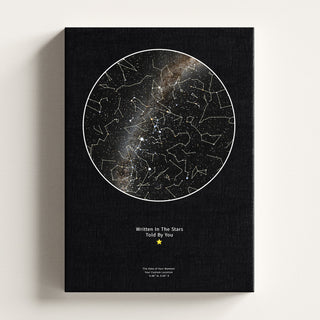
 Personalised Star Map | Custom Night Sky Print
From £21.99
View product →
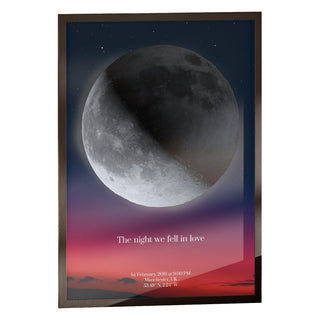
 Personalised Moon Map | by Skylit Studio
From £21.99
View product →
 Personalised Moon Phase Map for Family | by Skylit Studio
From £21.99
View product →
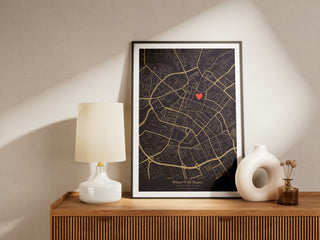
 Custom Location Map | Personalised Map Print by Skylit Studio
From £21.99
View product →
 Your Name From Orbit
From £21.99
View product →
 Print Your Universe - Custom Image Print
From £19.79
View product →
Keeping This Winter's Sky
There is a natural thought that comes with the end of the dark season: a particular night from this winter is worth holding on to. The evening you got engaged under a frosty sky, the night a grandchild was born in January, the first clear night you stood in the garden and actually looked up. Skylit Studio can draw that sky exactly as it was.

A personalised star map plots the real positions of the stars for the date, time and place you choose, calculated rather than approximated. If you are new to the idea, our explainer on what a star map is and how the real night sky becomes a print covers it from the beginning.
A custom moon phase print does the same for the Moon, showing the exact phase it wore that night. Our complete buyer's guide to personalised moon phase prints covers the styles and options, and if you are weighing up which night to choose, our piece on how to choose a date for a moon phase print helps narrow it down.
Pick the night that mattered, then write why underneath it. That pairing is what makes the print yours.
Skytalk, Skylit StudioWhat makes the print personal is the moment you choose and the message you add. The sky itself belongs to everyone who stood under it that night. The reason it was yours is the story you write beneath it.
Mothering Sunday, Easter and the Spring Calendar
The clock change sits in a busy stretch of the spring calendar. Mothering Sunday falls on 7 March 2027, three weeks before the clocks go forward, and Easter Sunday lands on 28 March 2027, the very same day as the change. If you are planning a gift for either, our personalised Mother's Day gifts page brings the options together in one place.
A personalised print sits comfortably alongside the spring classics. Flowers and chocolates are lovely on the day itself; a star map of the night she became a mum, or of the sky over the family home, is something that stays on the wall afterwards. Together they often make a fuller gift than either on its own.
Sizes, Frames and Delivery
Prints are available in A4, 30 x 40 cm, 40 x 50 cm, 50 x 70 cm and 60 x 80 cm. Unframed prints start at £21.99 for A4, and framed prints start at £36.98 for A4. Frames come in Black, White and Natural across every size, with Dark Brown available in A4, 30 x 40 cm and 40 x 50 cm.

Orders placed by 3pm Monday to Friday, excluding UK public holidays, are typically printed and dispatched the same working day, with free UK delivery via Royal Mail Tracked 48, arriving 2 to 4 working days after dispatch. An unframed A4 print ships flat in a rigid cardboard mailer, while unframed prints at 30 x 40 cm and larger are rolled and sent in a sturdy cardboard tube. Framed prints are wrapped in protective materials and boxed, and canvas prints arrive boxed and ready to hang.
If it is a gift, you can add gift wrapping and a gift message. You type the message at checkout and it is printed on a card, so it arrives ready to give.
Sunday 28 March 2027 is the evening the light starts winning. Before it does, there are still a few weeks of dark, starlit evenings to enjoy, and perhaps one of them to keep. Written In The Stars. Told By You.
Capture Your Moment in the Stars
Frequently Asked Questions
When do the clocks go forward in 2027 in the UK?
The clocks go forward on Sunday 28 March 2027. At 1am GMT the clocks move forward one hour to 2am, and British Summer Time begins. The change always falls on the last Sunday in March, which in 2027 is the 28th.
Do we lose or gain an hour when the clocks go forward?
You lose an hour. The night of Saturday 27 into Sunday 28 March 2027 is effectively 23 hours long, so there is an hour less in bed. In return, sunset reads roughly an hour later by the clock from that evening onwards.
When does BST start and end in 2027?
British Summer Time starts on Sunday 28 March 2027 and ends on Sunday 31 October 2027, when the clocks go back and GMT resumes for the winter.
Is the clock change on the same day as Easter in 2027?
Yes. Easter Sunday 2027 falls on 28 March, the same day the clocks go forward, so it is worth checking times for any early Easter services or family plans that morning.
Does the clock change affect stargazing?
The sky itself does not change, but darkness arrives an hour later by the clock. On 28 March, full darkness in London comes at roughly 9.20pm BST, and by late April it is close to 11pm. The weeks before the clocks go forward are the last stretch of the season when you can see a properly dark sky early in the evening.
Can I order a star map for a night from this past winter?
Yes. A star map is calculated for any date, time and place you enter, so you can choose a night from this winter, years ago, or a date still to come. The sky is plotted as it appeared from that location at that moment.
How quickly will my print arrive?
Orders placed by 3pm Monday to Friday are typically dispatched the same working day. Free UK delivery via Royal Mail Tracked 48 then takes 2 to 4 working days.


