


A sunset time will not tell you when the stars come out, and it will not tell you what you will actually see once they do. The Sun dropping below the horizon only begins the transition. Over the two hours that follow, the sky runs through three distinct stages, from the first bright planet to the full depth of the Milky Way, and each one looks genuinely different.
Sunset Is Not Darkness
Sunset is the moment the upper edge of the Sun's disc slips below the horizon where you are standing. What follows is twilight: sunlight scattering through the upper atmosphere and lighting the sky from below the horizon line. The Sun has set. Its light has not stopped arriving.
Astronomers measure twilight by how far the centre of the Sun has sunk below the horizon, in degrees. Those thresholds are fixed worldwide, which is why astronomical twilight has a real, checkable meaning.
The Three Stages of Twilight
Civil Twilight: 0 to 6 Degrees Below the Horizon
The golden-then-blue stretch immediately after sunset. There is still enough natural light to walk a footpath or read a road sign without lamps, and it is the reference point behind lighting-up times.
The first celestial objects appear here. Venus, Jupiter and bright stars such as Vega and Capella show up before civil twilight ends, which is why the first "star" of the evening is so often a planet. Our guide to identifying that bright object covers how to tell them apart.
Nautical Twilight: 6 to 12 Degrees Below
Named for the sailors who needed it. The sea horizon stays faintly discernible while the brighter stars are already out, exactly the combination a sextant needs. On land, this is where the sky reads as genuinely dark and constellation shapes become traceable. Most people would call it night.
Astronomical Twilight: 12 to 18 Degrees Below
The last of the scattered sunlight drains away here. It is invisible to the eye but still measurable, and it still washes out the faintest objects. Once the Sun passes 18 degrees below the horizon, twilight ends and the sky is as dark as it will get. That is true astronomical darkness, and it is when the Milky Way and the full depth of the star field arrive.
Sunset starts the process. Eighteen degrees finishes it.
Skylit StudioHow Long After Sunset Until It Is Actually Dark?
Roughly one hour and forty-five minutes to two hours and fifteen minutes, depending on the date and how far north you are. The Sun sets at a shallow angle at UK latitudes, so it takes its time descending those eighteen degrees. Nearer the equator, night falls fast.
Approximate times for central and southern England. Add roughly fifteen minutes for the Midlands and North, half an hour for central Scotland. Times are BST until the clocks change on 25 October 2026, then GMT.
| Date | Sunset | First stars (civil twilight ends) | Astronomical dark begins |
|---|---|---|---|
| 1 September | 19:45 | 20:20 | 21:50 |
| 21 September | 19:00 | 19:30 | 20:45 |
| 1 October | 18:35 | 19:10 | 20:25 |
| 25 October (clocks back) | 16:45 | 17:20 | 18:35 |
| 1 December | 15:55 | 16:35 | 18:00 |
| 21 December | 15:55 | 16:35 | 18:05 |
| 1 February | 16:50 | 17:30 | 18:45 |
One detail worth noticing: the gap between sunset and darkness is shortest around the equinoxes, because the Sun's path meets the horizon most steeply in late September. December's darkness arrives at a far earlier clock time, but it takes longer to get there.
What Time Does It Get Dark in September?
September is the month British stargazers wait for, and not just for earlier sunsets. Between mid-May and late July, southern England gets no astronomical darkness at all: the Sun never sinks a full eighteen degrees below the horizon, so the sky stays in twilight through the small hours. In northern Scotland that window runs from late April to mid-August, which is where the "simmer dim" comes from.

True darkness returns to England in the first days of August, but at an unsociable hour. By the start of September it arrives just before ten at night, and by the autumn equinox shortly before nine. That is when the season turns practical: dark enough for real stargazing, early enough to take children out, still mild.
Autumn, the Clocks and the Long Nights
The biggest jump comes on the last Sunday of October, when British Summer Time ends and every evening time shifts back an hour. Sunset moves from around half five to around half four, and full darkness arrives before seven. We covered when the clocks go back in 2026 in detail.
November to January brings the best run of dark hours in the year, and the winter constellations are the richest on offer, with Orion, Taurus and the Pleiades over the southern sky. Our round-up of the best stargazing spots in the UK picks out the dark-sky sites worth the drive.
Make it personal
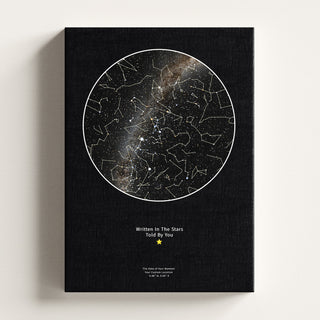
 Personalised Star Map | Custom Night Sky Print
From £21.99
View product →
Personalised Star Map | Custom Night Sky Print
From £21.99
View product →
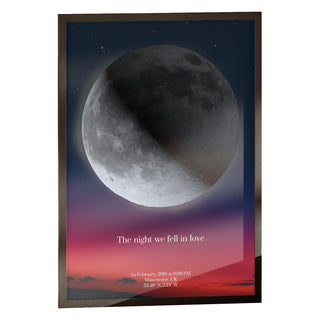
 Personalised Moon Map | by Skylit Studio
From £21.99
View product →
Personalised Moon Map | by Skylit Studio
From £21.99
View product →
 Personalised Moon Phase Map for Family | by Skylit Studio
From £21.99
View product →
Personalised Moon Phase Map for Family | by Skylit Studio
From £21.99
View product →
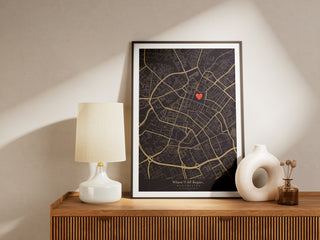
 Custom Location Map | Personalised Map Print by Skylit Studio
From £21.99
View product →
Custom Location Map | Personalised Map Print by Skylit Studio
From £21.99
View product →
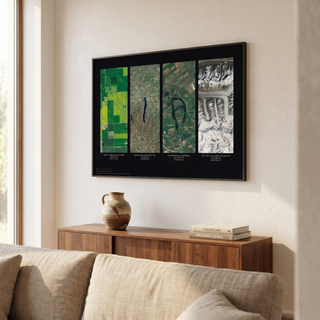
 Your Name From Orbit
From £21.99
View product →
Your Name From Orbit
From £21.99
View product →
 Print Your Universe - Custom Image Print
From £19.79
View product →
Print Your Universe - Custom Image Print
From £19.79
View product →
So When Can You Actually See Stars Tonight?
Here is the practical version, stripped of the degrees. Work from your local sunset time and count forward.

Your Evening, Stage by Stage
- Sunset to about 20 minutes after: colour in the west. Venus or Jupiter may already be visible.
- 25 to 40 minutes after sunset: the first true stars arrive, a handful of the brightest only.
- About 1 hour after sunset: nautical twilight. Constellation patterns become traceable, and most people would call it dark.
- 1 hour 45 to 2 hours 15 after sunset: astronomical darkness. The Milky Way and faint objects become available.
- Add 20 to 30 minutes: your eyes need that long to dark-adapt. Stay off your phone, or the count starts again.
That last point is often skipped. Dark adaptation is physiological, not atmospheric, and one glance at a bright screen undoes much of it. To plan a specific night, our free interactive night sky explorer renders the real sky for any location, date and time you enter, so you can see what will be above you at half nine rather than guessing. Our guide to the free interactive star chart explains how to get the most from it, and if you would rather just walk outside and look up, what you can see tonight with no equipment is the place to start.
The Two Things That Undo Astronomical Dark
You can time an evening perfectly, wait out all three stages of twilight, and still find the sky disappointing. Two factors account for almost all of it, and the first one is overhead.
The Moon
A full Moon is the most effective natural light polluter there is. It rises around sunset, stays up all night, and washes out everything but the brightest few dozen stars. The darkest skies of any month fall in the week either side of new Moon, when the Moon is absent or a thin crescent that sets soon after the Sun.
So observers plan around lunar phase rather than the calendar. Meteor watching in particular lives or dies by it, which is why our meteor shower guide lists Moon conditions alongside each peak date. Check the phase before you commit to a night.
That same Moon is worth recording when it belongs to a date that matters. A personalised moon phase print shows it in the exact phase it held on a chosen date, and picking that date is its own decision, which we talked through in how to choose a date for a moon phase print.
Light Pollution
The second factor is the one you can fix by driving. Under a genuinely dark rural sky the naked eye picks out a couple of thousand stars at once and the Milky Way is an obvious band overhead. From a suburban garden that drops sharply. From an inner-city street you may be down to a few dozen. Getting away from streetlights does more for the view than any equipment.
Why the Time Matters as Much as the Date
Everything above comes down to one idea. The sky is not a property of a date. It is a property of a moment. Nine o'clock and midnight on the same night in the same field give visibly different skies, because the Earth has turned in between and different constellations have climbed above the eastern horizon.

That is why a personalised star map from Skylit Studio asks for a time as well as a date and a place. The chart is calculated for that precise hour, so the print shows the sky as it stood at the moment you chose. Change the time by three hours and the map changes. Positions come from the same catalogues professional astronomy relies on, and we explained the method in how the real night sky is calculated.
So the time field is worth a moment's thought rather than a default. For a birth, the time on the certificate. For a wedding, the vows or the first dance. For the night you met, whatever hour you remember it as. What makes the print personal is not the astronomy alone. It is the moment you chose, paired with the words beneath it. Written In The Stars. Told By You.
Create Your Star Map for a Date and Time
Frequently Asked Questions
How long after sunset does it get dark in the UK?
Roughly one hour and forty-five minutes to two hours and fifteen minutes, depending on the date and your latitude. The first stars appear far sooner, about twenty-five to forty minutes after sunset, once civil twilight ends.
What time does it get dark in September in the UK?
On 1 September in central England the Sun sets around 19:45 BST, the first stars appear around 20:20 and full darkness arrives around 21:50. By the equinox on 21 September those times shift to roughly 19:00, 19:30 and 20:45. Scotland runs about half an hour later at each stage.
What is the difference between nautical twilight and civil twilight?
Both are defined by how far the Sun has sunk below the horizon. Civil twilight runs from sunset to six degrees below, with enough light for outdoor activity without lamps. Nautical twilight runs from six to twelve degrees, when the sea horizon is still faintly visible while the brighter stars are out. Astronomical twilight follows, from twelve to eighteen.
Does the UK ever get completely dark in summer?
No. From mid-May to late July, southern England never sees the Sun drop a full eighteen degrees below the horizon, so the sky stays in twilight all night. In northern Scotland that window runs from late April to mid-August, and Shetland does not even reach nautical darkness in June. True darkness returns in early August.
What is the best time to stargaze in the UK?
Between the end of astronomical twilight and the start of dawn, on a night close to new Moon, away from streetlights. September through March gives you those conditions at a reasonable hour. Allow twenty to thirty minutes for your eyes to dark-adapt before judging what you can see.
Does a star map show the sky at a specific time or just the date?
Both. Each map is calculated for a date, a time and a place, because the sky rotates through the night and looks measurably different at nine o'clock than at midnight. Entering the actual hour gives the sky as it genuinely stood.
What sizes and prices do the prints come in?
Star maps and moon phase prints share one range: A4, 30 x 40 cm, 40 x 50 cm, 50 x 70 cm and 60 x 80 cm, unframed or framed, with gallery-wrapped canvas up to 50 x 70 cm. Unframed prints start at £21.99, framed from £36.98 and canvas from £49.99. Orders placed by 3PM on a working day are dispatched the same day.
The answer to when it gets dark in the UK depends what you mean by dark, and the useful version is about two hours after the sunset time you looked up. Give the sky that long, give your eyes another half hour, pick a week away from the full Moon, and the gap between a disappointing evening outside and a memorable one turns out to be mostly patience.


