




Step outside on a clear January evening anywhere in Britain, face south, and one shape is hard to miss: three bright stars in a short, neat row, framed by four more in a rough hourglass. That is Orion, the hunter, and for many people it is the first constellation they ever learn to recognise.
This guide covers the Orion constellation meaning, from the Greek myth behind the figure to the stars that build it. It then covers when Orion is visible from the UK, how to find it, and how to use Orion's Belt as a signpost to other winter stars. No telescope needed.
Orion Constellation Meaning: Who Was the Hunter?
The name comes from Greek mythology. Orion was a giant huntsman, in most tellings the son of the sea god Poseidon, so strong and so skilled that he was said to be able to walk across the sea. In the sky he stands with a belt across his middle and a sword hanging from it, one arm raising a club and the other holding a shield towards Taurus, the bull.
Orion is one of the 48 constellations listed by the astronomer Ptolemy in the second century, and it survives as one of the 88 official constellations recognised by the International Astronomical Union today. Our explainer on IAU constellations and zodiac signs explains how those official figures differ from horoscope signs. Orion is not a zodiac constellation. The Sun never passes through it.

The Hunter Myth and the Scorpion
There are several versions of how Orion died. In the best known, Orion boasted that he would hunt down every animal on Earth. The Earth goddess Gaia, offended, sent a giant scorpion to stop him, and its sting killed him. Zeus placed both hunter and scorpion among the stars, but on opposite sides of the sky, so the two would never meet again.
The sky keeps that promise. Orion is a winter constellation, and Scorpius, the scorpion, belongs to summer. As Scorpius rises in the east, Orion is setting in the west, and you will never see both fully above the horizon at the same time. Whichever version you prefer, the hunter's two dogs follow at his heels: Canis Major and Canis Minor.
The hunter rises as the scorpion sets. Thousands of years on, the sky still keeps them apart.
Skylit StudioThe Stars That Make Orion
Orion is easy to learn because it holds several of the brightest stars in the sky, arranged in a shape that genuinely looks like a figure.
Orion's Belt: Alnitak, Alnilam and Mintaka
The three stars of Orion's Belt sit in an almost straight line, evenly spaced and of similar brightness. From left to right as you see them from the UK, they are Alnitak, Alnilam and Mintaka. Alnilam, in the middle, comes from an Arabic phrase usually translated as "string of pearls". Mintaka lies almost exactly on the celestial equator, which is why Orion can be seen from nearly every inhabited part of the world.
Betelgeuse: the red shoulder
At the upper left of the figure, marking Orion's shoulder, is Betelgeuse. Even with the naked eye it has a clear orange-red tint, because it is a red supergiant, a vast, cool, ageing star several hundred light years away. Its brightness varies, and in early 2020 it faded so noticeably that it made headlines before recovering.
Rigel: the blue-white foot
Diagonally opposite, at the lower right, is Rigel, the hunter's foot. It is a blue-white supergiant and usually the brightest star in Orion. The colour contrast with Betelgeuse is one of the easiest ways to see that stars are not all the same white.
Bellatrix, Saiph and the sword
Bellatrix marks the other shoulder, upper right, and Saiph the other knee, lower left. Below the belt hangs a fainter line of stars, Orion's Sword, whose middle looks slightly fuzzy.
The Orion Nebula (M42)
That fuzzy patch in the sword is the Orion Nebula, catalogued as M42. It is a vast cloud of gas and dust, roughly 1,300 light years away, where new stars are forming. From a dark site it shows to the naked eye as a soft smudge, and binoculars reveal a glowing cloud.
When Is Orion Visible From the UK?
Orion is the signature constellation of the British winter. As the Earth orbits the Sun, the evening stars change through the year, and from the UK Orion owns the evening sky from roughly November to March.
- Late October and November: Orion rises in the east late in the evening and is well placed in the small hours. Late October is also when the Orionid meteor shower peaks, its meteors appearing to fly out from near Orion's raised club.
- December: Orion is up by mid-evening and at its highest in the south around midnight.
- January: the best month for most people. Orion stands high in the south during the evening, comfortably placed before bedtime.
- February and March: Orion is already in the south as darkness falls and drifts westward through the evening.
- April onwards: it sinks lower in the west after sunset and is soon lost in the twilight. Through the summer it is too close to the Sun to see in the evening at all.
Winter is also when darkness arrives early, so Orion is visible in ordinary evening hours. Our guide to when it gets dark in the UK explains how twilight shifts through the year.
How to Find Orion in the Night Sky
Here is how to find Orion in the night sky on a clear winter evening.

- Face south. Roughly where the Sun was at midday.
- Look part-way up. From the UK, Orion never climbs overhead. It stands at a comfortable height above the southern horizon.
- Find three bright stars in a short, straight row. That is Orion's Belt. Nothing else in the winter sky looks quite like it.
- Look above and below the belt. The orange star above and to the left is Betelgeuse. The blue-white star below and to the right is Rigel.
- Give your eyes ten minutes away from bright lights, and the sword comes into view.
Orion is bright enough to see from most towns. For more naked-eye sights to try once you have it, see our guide to what you can see in the UK night sky with no equipment. If you would rather practise before you head out, our interactive night sky explorer shows exactly where Orion sits for any date and place.
Make it personal
 Personalised Star Map | Custom Night Sky Print
From £21.99
View product →
 Personalised Moon Map | by Skylit Studio
From £21.99
View product →
 Personalised Moon Phase Map for Family | by Skylit Studio
From £21.99
View product →
 Custom Location Map | Personalised Map Print by Skylit Studio
From £21.99
View product →
 Your Name From Orbit
From £21.99
View product →
 Print Your Universe - Custom Image Print
From £19.79
View product →
Using Orion's Belt as a Signpost
Once you can find Orion's Belt, you have a pointer to most of the other bright landmarks in the winter sky.
Down and to the left: Sirius
Follow the line of the belt down and to the left, and the first very bright star you reach is Sirius, in Canis Major, the larger of the hunter's dogs. Sirius is the brightest star in the night sky, and because it stays fairly low from the UK it often twinkles and flashes colours. Our quick guide to identifying a bright star helps you tell it from a planet.
Up and to the right: Aldebaran and the Pleiades
Now follow the belt the other way, up and to the right. You will reach Aldebaran, an orange star that marks the eye of Taurus, the bull Orion faces. A little further on is the Pleiades, the misty cluster called the Seven Sisters. Taurus is a zodiac constellation, covered in our zodiac constellations sky guide.
The Winter Triangle
Betelgeuse, Sirius and Procyon, the brightest star of Canis Minor, form a large, near-equilateral triangle known as the Winter Triangle. Extend a line from Rigel up through Betelgeuse and you reach Castor and Pollux, the twins of Gemini.
Orion and the Plough: Two Shapes Every Beginner Learns
So what is the Plough constellation? Strictly, it is not a constellation at all. It is an asterism, a recognisable pattern of seven bright stars that forms part of a larger official constellation, Ursa Major, the great bear.
The two make a useful pair. On a winter evening Orion is in the south, while the Plough sits in the north-east, standing on its handle. The two end stars of its bowl point towards Polaris, the North Star. Learn Orion for the south and the Plough for the north, and you can orientate yourself on any clear winter night. For a wider tour of the constellations visible in the UK winter sky and through the rest of the seasons, see our complete guide to constellations in the UK sky.
Finding Orion on the Night That Matters to You
Because Orion is so recognisable, it is often the first figure people look for on a star chart. Spot the belt, and everything around it starts to make sense.

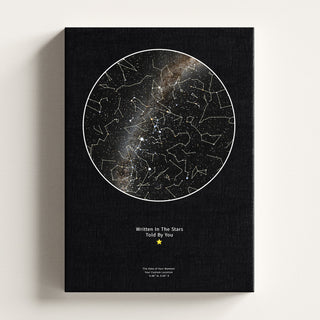
A personalised star map from Skylit Studio plots the sky as it actually looked from a chosen place at a chosen date and time. Stars are sized by brightness and faint lines join the constellation figures, so a hunter standing above a winter night will be there on the print where he really was. Our explainer on how the real night sky becomes a print covers the method in more detail.
The date decides what appears. An evening wedding in December, a January birth after dark or a February proposal under the stars will very likely put Orion on the chart, often with Sirius and Taurus close by. A midsummer night will not show him at all. Instead you might find Scorpius low in the south, which is the old myth playing out on paper. Each is a faithful picture of that particular night.
The stars are where they were that night. The date, the place and the words are yours.
Skylit StudioWhat makes the print personal is the moment you choose and the message you add beneath it. If you are deciding between dates, our guide on how to personalise a custom star map walks through the time, place and wording choices. Prints come in A4, 30 x 40 cm, 40 x 50 cm, 50 x 70 cm and 60 x 80 cm, unframed from £21.99 and framed from £36.98, and orders placed by 3pm on a working day are dispatched the same day. Written In The Stars. Told By You.
Frequently Asked Questions
What is the meaning of the Orion constellation?
Orion represents a giant hunter from Greek mythology, usually the son of Poseidon, drawn with a raised club, a shield, a belt of three stars and a sword. In the best-known myth he was killed by a scorpion, and Zeus placed the two on opposite sides of the sky, which is why Orion and Scorpius are never seen together.
What are the three stars of Orion's Belt called?
From left to right as seen from the UK, they are Alnitak, Alnilam and Mintaka. The names come from Arabic.
When can I see Orion in the UK?
Orion is best seen on winter evenings, roughly from November to March. It stands highest in the south during January evenings and slips into the western twilight by April.
How do I find Orion in the night sky?
Face south on a clear winter evening and look part-way up the sky for three bright stars in a short, straight row. That is Orion's Belt, with orange Betelgeuse above and blue-white Rigel below.
Is the Plough a constellation?
Not officially. The Plough is an asterism, a pattern of seven bright stars within the larger constellation Ursa Major. Two of its stars point to Polaris.
Will Orion appear on my personalised star map?
It depends on the date, time and place you choose. Orion is above the horizon on most winter evenings in the UK, so a night between November and March will often include him. A summer evening date will show a different set of constellations, plotted exactly as they appeared that night.


