


Everyone knows their star sign, yet far fewer people have actually seen the constellation it is named after. Happily, the zodiac constellations are some of the easiest star patterns to track down once you know where to look. They all sit along one curving band across the sky, they take turns through the year, and a few bright signposts lead you straight to them.
This guide covers the zodiac constellations and their locations: the line they follow, when each is on show from the UK, and the star-hops that lead you to them.
Where Are the Zodiac Constellations?
The twelve zodiac constellations are Aries, Taurus, Gemini, Cancer, Leo, Virgo, Libra, Scorpius, Sagittarius, Capricornus, Aquarius and Pisces. They are the official constellations that the Sun appears to pass in front of over the course of a year, so they form a ring that circles the whole sky.
From the UK, that ring arcs across the southern half of the sky. It climbs high on winter nights and stays low on summer nights. The constellations in the Sun's direction are lost in daylight, so each one has its own season for the best views.
If you would like the background on how astronomers define a constellation in the first place, our post on IAU constellations and how they differ from zodiac signs explains the 88 official regions and where the twelve zodiac ones fit.
The Ecliptic: the Road the Zodiac Lines
As Earth orbits the Sun, our view of the Sun shifts slowly against the background stars, completing one full lap each year. The path it traces is called the ecliptic, and the zodiac constellations are simply the ones that lie along it.
The ecliptic is also the plane of the Solar System, which makes it doubly useful. The Moon and the planets all travel close to the same line, so a bright "star" sitting in Leo or Taurus that is missing from your chart is very likely a planet.
Find the ecliptic and you have found the zodiac, the Moon and the planets in one go.
Star Sign Dates and the Real Sky
Here is the detail that surprises most people. Astrological dates were set around two thousand years ago, and the sky has shifted since, so your star sign and the constellation behind the Sun on your birthday are usually different.
The cause is precession. Earth's axis wobbles slowly, like a spinning top, completing one circuit roughly every 26,000 years. That wobble gradually slides the spring equinox point westward along the ecliptic, by about one degree every 72 years.
Western astrology uses the tropical zodiac, which stays fixed to the seasons rather than the stars. So astrological Aries still begins at the spring equinox around 21 March, yet on that date the Sun now sits in front of Pisces. In practice, on most birthdays the Sun is in the constellation before the one the star sign is named after. Today, in early October, astrology says Libra while the Sun is genuinely crossing Virgo.
One is a calendar tied to the seasons, the other a map of the stars. For the astrological dates, see the astrological dates for each sign, and for the stories behind each sign our guide to the 12 zodiac signs goes through them one by one.
There is a practical upshot for stargazers too. Around your birthday, your zodiac constellation is sitting close to the Sun and is invisible. The best evening views usually come six to eight months later, when Earth has carried you round to the far side of your orbit.
When to See Each Zodiac Constellation From the UK
The table below gives the best evening season for each zodiac constellation from the UK, meaning the months when it is well placed in the southern sky around 10pm.
| Constellation | Landmark to look for | Best UK evening season |
|---|---|---|
| Aries | Hamal, a modest orange star | Late autumn (November to December) |
| Taurus | Aldebaran and the Pleiades | Winter (December to February) |
| Gemini | Castor and Pollux | Late winter (January to March) |
| Cancer | The Beehive Cluster | Late winter and early spring (February to April) |
| Leo | Regulus and the Sickle | Spring (March to May) |
| Virgo | Spica | Late spring (April to June) |
| Libra | Two faint "claw" stars | Early summer, low in the south (May to July) |
| Scorpius | Antares, a red star | Summer, very low in the south (June to July) |
| Sagittarius | The Teapot | Summer, very low in the south (July to August) |
| Capricornus | A faint wide triangle | Late summer and early autumn (August to October) |
| Aquarius | The Water Jar | Autumn (September to November) |
| Pisces | The Circlet | Autumn (October to December) |
Because the sky turns through the night, a constellation from the next season along will be up by the small hours. Winter's Taurus is already climbing in the east well before midnight in October, for example.
Winter: Taurus, Gemini and Orion's Helping Hand
Winter is the best season of all for zodiac spotting from Britain, with the ecliptic riding high through long, dark nights.
Start with Orion, a non-zodiac constellation that makes the perfect anchor (our guide to constellations in the UK sky covers it and its neighbours). Follow the three stars of Orion's Belt up and to the right and you reach Aldebaran, the orange eye of Taurus, sitting in a V-shaped group called the Hyades. Keep going in the same direction and you arrive at the Pleiades, the tight little cluster also known as the Seven Sisters, which also belongs to Taurus.
For Gemini, draw a line from Rigel at Orion's lower right through Betelgeuse at his upper left and carry on. You reach a pair of bright stars side by side: Castor and Pollux, the heads of the Twins.
Spring: Cancer, Leo and Virgo
As the evenings lengthen, the zodiac's spring trio takes over the southern sky, and the Plough becomes your best guide.
Cancer is the faintest of the zodiac constellations, sitting between Gemini and Leo. Its treasure is the Beehive Cluster, which appears as a soft, misty patch to the naked eye under a dark sky and bursts into dozens of stars through binoculars.
For Leo, find the two pointer stars of the Plough, the pair that lead up to the Pole Star, and follow them the opposite way, away from Polaris. You drop onto the back of the Lion. Look for a backwards question mark of stars, known as the Sickle, which marks Leo's head and mane, with bright Regulus at its base.
For Virgo, follow the curve of the Plough's handle away from the bowl. "Arc to Arcturus", the bright orange star of Boötes, then "speed on to Spica", the blue-white star that marks Virgo. Virgo is the largest of the zodiac constellations, so Spica is the easiest place to begin.
Make it personal
 Personalised Star Map | Custom Night Sky Print
From £21.99
View product →
Personalised Star Map | Custom Night Sky Print
From £21.99
View product →
 Personalised Moon Map | by Skylit Studio
From £21.99
View product →
Personalised Moon Map | by Skylit Studio
From £21.99
View product →
 Personalised Moon Phase Map for Family | by Skylit Studio
From £21.99
View product →
Personalised Moon Phase Map for Family | by Skylit Studio
From £21.99
View product →
 Custom Location Map | Personalised Map Print by Skylit Studio
From £21.99
View product →
Custom Location Map | Personalised Map Print by Skylit Studio
From £21.99
View product →
 Your Name From Orbit
From £21.99
View product →
Your Name From Orbit
From £21.99
View product →
 Print Your Universe - Custom Image Print
From £19.79
View product →
Print Your Universe - Custom Image Print
From £19.79
View product →
Summer: Libra, Scorpius and Sagittarius
Summer asks a little more patience from UK stargazers. The ecliptic runs low across the southern horizon after dark, and from mid-May to late July much of the country never reaches full astronomical darkness. A clear, flat southern horizon makes all the difference.
Libra sits between Spica and Antares. Its two main stars, Zubenelgenubi and Zubeneschamali, whose names come from the Arabic for the southern and northern claw, are modest but findable on a clear night.
Scorpius hugs the southern horizon from Britain. Look due south around midnight in June and early July for Antares, a distinctly red star whose name means "rival of Mars". Its famous curling tail stays below the horizon for most of the UK, so seeing it is a good reason to plan a holiday further south.
Sagittarius follows just behind, low in the south in July and August. Its brightest stars form an asterism shaped like a teapot, and on a dark night the Milky Way rises from its spout like steam.
Autumn: Capricornus, Aquarius, Pisces and Aries
Autumn brings darkness back at a sensible hour, and with it a stretch of the zodiac often called the "watery" region of the sky. These fainter patterns reward a dark site.
For Capricornus, start at the Summer Triangle, still bright in the west on autumn evenings. Draw a line from Vega through Altair and continue downwards: you reach Algedi, at the western tip of the Sea Goat's broad triangle of stars.
For Aquarius and Pisces, use the Great Square of Pegasus, four stars marking a huge box high in the south-east. Below the Square's southern side sits a small ring of stars called the Circlet, the head of one of the Fishes of Pisces. To the west of the Circlet, look for a small Y-shaped group known as the Water Jar, the heart of Aquarius.
Aries rounds off the year. Look between the Square of Pegasus and the Pleiades for a short, slightly bent line of stars led by Hamal, which is the brightest star in Aries.
What You Can Find in October
October is a lovely month to try this, because darkness falls early and several zodiac constellations are on show at once. Around 9pm, Sagittarius is setting low in the south-west, Capricornus sits low towards the south, and Aquarius and Pisces fill the south and south-east beneath the Great Square. Aries is climbing in the east, and by late evening the Pleiades and Aldebaran have risen in the east as a preview of winter.

For a broader checklist of what is above you this week, our guide to the night sky tonight in the UK covers the planets and bright stars too. You can also scroll through any date and hour in the Night Sky Explorer, or try our free interactive star chart to see the zodiac turning across the sky.
Seeing the Zodiac on a Star Map
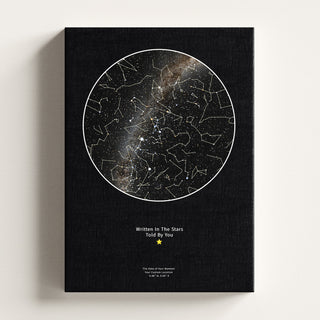
Whichever zodiac constellations were above the horizon at your chosen moment appear in their true positions on a personalised star map from Skylit Studio. Each map is calculated for the date, time and place you choose, so a December evening wedding over Manchester shows Taurus and Gemini riding high, while a midsummer midnight shows Scorpius skimming the southern edge. Our post on how to see the night sky on a specific date and location explains how that moment is worked out, and how star maps are calculated goes into the astronomy.
For star sign fans, the Zodiac ring chart shape places the twelve sign glyphs around the chart and turns so the sun sign for your chosen date sits at the top, while the chart inside shows the real sky. The moment you pick, and the words you add beneath it, are what make it yours.
Frequently Asked Questions
Are zodiac constellations the same as star signs?
They share names but measure different things. Star signs are twelve equal 30 degree slices of the year, tied to the seasons. Zodiac constellations are real star patterns along the Sun's path, with uneven official boundaries, so the Sun spends anything from about a week to well over a month in each one.
Why don't zodiac constellations line up with astrology dates anymore?
Precession. Earth's axis slowly wobbles over about 26,000 years, shifting the spring equinox point along the ecliptic. Astrological dates were fixed around two thousand years ago, and since then the sky has drifted by almost a whole constellation, so on most birthdays the Sun is in front of the constellation before the one the sign is named after.
What is the best time of year to see my zodiac constellation?
Usually six to eight months after your birthday, when it is well placed in the evening sky. Around your birthday the Sun sits close to it and hides it in daylight. The seasonal table in this guide gives the best UK evening months for each one.
Can I see all 12 zodiac constellations at once?
At any moment about half of the zodiac is above the horizon, and the other half is below it or lost in daylight. On a long winter night you can watch Pisces and Aries in the evening give way to Leo and Virgo before dawn.
Do I need a telescope to find zodiac constellations?
Your eyes are all you need. A dark site away from streetlights helps with fainter ones like Cancer, Capricornus and Pisces, and binoculars are a lovely extra for the Pleiades and the Beehive Cluster.
Is Ophiuchus a zodiac constellation?
Ophiuchus lies on the ecliptic, and the Sun crosses it from roughly late November to mid December, so astronomically it is a thirteenth constellation on the Sun's path. From the UK it is best seen on summer evenings above Scorpius.
Once you have found one zodiac constellation, the rest follow naturally, because they all line the same road through the sky. Pick a clear evening, find the season's signpost, and work along the ecliptic one constellation at a time.


